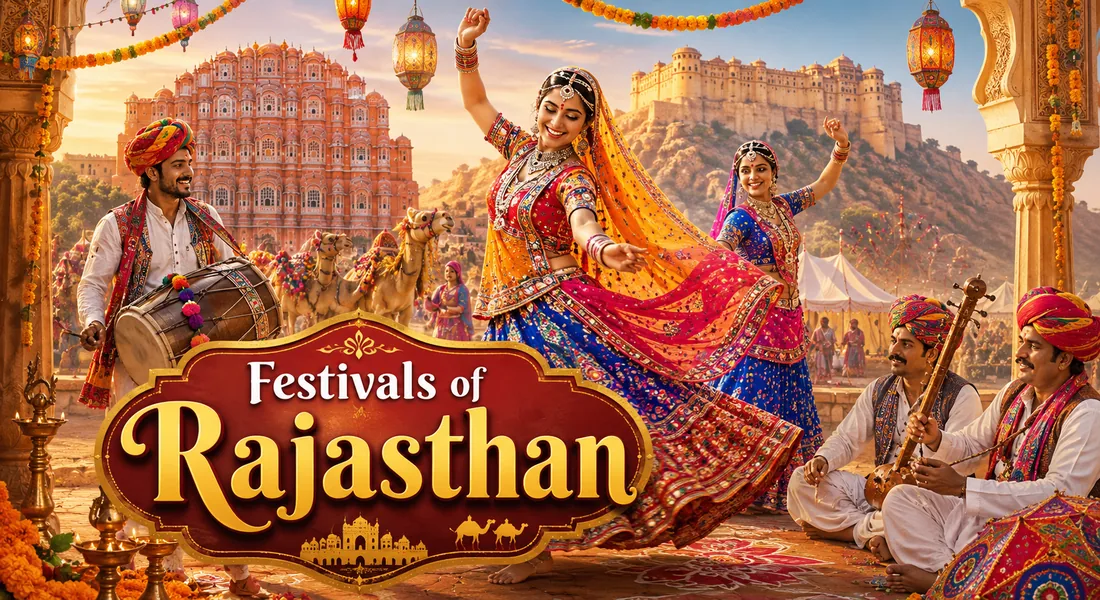
Rajasthan Festivals: Month-Wise List, Dates & Places
Rajasthan runs on two festival calendars at once. One is religious and community-led, set by lunar dates, observed in neighbourhood shrines and family courtyards. The other is a tourism programme with stages, seating and a published schedule. Both are real. They are not the same thing, and turning up to the first expecting the second is how visitors end up standing in someone's private worship with a camera.
This guide covers both: what happens when, where, and how to attend without getting in the way. Dates below follow the Rajasthan Tourism Department's published 2026 calendar. Government calendars get revised and day-wise schedules often land only a few weeks out, so confirm on the official event page before you book anything non-refundable.
The Rajasthan Festival Calendar at a Glance
Most of these festivals recur in roughly the same window each year, which is why the typical period column matters more than the exact 2026 dates once that year has passed. Rajasthan Tourism usually publishes the following year's calendar in the closing months of the current one.
| Festival | Place | Typical period | Official 2026 dates |
|---|---|---|---|
| Bikaner Camel Festival | Bikaner | Early January | 10–11 January |
| Kite Festival | Jaipur | Makar Sankranti | 14 January |
| Nagaur Fair | Nagaur | Late January | 24–27 January |
| Beneshwar Fair | Dungarpur region | Magh Purnima | 28 Jan – 1 Feb |
| Desert Festival | Jaisalmer | Around Magh Purnima | 30 Jan – 1 Feb |
| Gangaur | Jaipur, Udaipur, statewide | March or early April | 21–22 March |
| Mewar Festival | Udaipur | With Gangaur | 21–23 March |
| Summer Festival | Mount Abu | Early to mid May | 9–10 May |
| Teej Festival | Jaipur | Sawan, Jul–Aug | 14–15 August |
| Kajli Teej | Bundi | A fortnight after Teej | 31 Aug – 1 Sep |
| Abhaneri Festival | Dausa district | Mid October | 12–13 October |
| Kota Dussehra Fair | Kota | From Dussehra, 2–3 weeks | 20 Oct – 6 Nov |
| Marwar Festival | Jodhpur | Sharad Purnima | 24–25 October |
| Pushkar Fair | Pushkar | Ending at Kartik Purnima | 17–24 November |
| Chandrabhaga Fair | Jhalrapatan | Late November | 23–25 November |
| Matsya Festival | Alwar | Late November | 25–26 November |
| Bundi Festival | Bundi | Late November | 27–29 November |
| Kumbhalgarh Festival | Rajsamand | Early December | 1–3 December |
| Ranakpur Festival | Pali district | Late December | 21–22 December |
| Winter Festival | Mount Abu | New Year period | 29–31 December |
One thing worth knowing: religious festivals move against the Gregorian calendar because they follow lunar dates. Gangaur can land in March one year and early April the next. Never book flights against last year's date.
January: Camels, Kites and the Cold Desert
Bikaner Camel Festival
Two days built around the animal that made the Thar habitable. Decorated camels, competitions, folk performance and a fair atmosphere spread across grounds in and near the city. Held 10–11 January in 2026.
Bikaner in January is genuinely cold at dawn and pleasant by noon, so dress in layers you can shed. Book rooms early; the city's hotel stock is modest and the festival fills it. Events run at more than one venue, so check the programme rather than assuming everything happens in one place. And if a handler is pushing an animal that looks distressed or overloaded, don't reward it with your attention or your money.
Jaipur Kite Festival
On Makar Sankranti, 14 January, the sky over Jaipur fills with kites from morning until dark. Rooftops become the whole city's living room. It is one of the best things Rajasthan does.
It is also the festival with a real injury record. Manja coated with glass or metal cuts birds out of the air and has caused serious injuries to motorcyclists at street level. Use legal, bird-safer thread, keep away from roads and power lines, and pause during the hours authorities flag for bird movement. Join through an organised rooftop with parapet walls and a sensible headcount. Do not follow a stranger up an unfamiliar staircase because the view looked better from below.
Nagaur Fair
Four days of livestock trade, 24–27 January in 2026, and considerably less polished than Pushkar. Cattle, camels, bullocks and horses change hands while a cultural programme runs alongside.
Traders arrive and leave on their own schedule, which rarely matches the official programme, so the fair can feel very different on day one and day four. Go with a guide who knows which areas are working grounds and ask before taking portraits. Mornings are colder than most visitors pack for, and the dust gets into camera bodies.
Late January to February: Jaisalmer and Beneshwar
Jaisalmer Desert Festival
Maru Mahotsav, listed for 30 January to 1 February 2026, is the state's showpiece desert event: folk music, dance, turban-tying and moustache competitions, camel events and a closing programme on the dunes.
Venues split between the city and the sand, so work out transport before you arrive rather than assuming everything happens at the fort or at Sam.
Camp rates climb steeply around these dates, and many camps advertise a "festival programme" that is their own nightly show, not the official event. Ask directly which one you are paying for. Our Jaisalmer desert safari guide compares camps and activities in more detail.
Beneshwar Fair
Held where the Som, Mahi and Jakham rivers meet in southern Rajasthan, Beneshwar draws Bhil and other communities in very large numbers for pilgrimage, ritual bathing and temple observance. The 2026 window is 28 January to 1 February.
Approach this one differently from the tourism festivals. It is a religious gathering that happens to be photogenic, not an event staged for visitors. Go with a local guide, ask before photographing anyone, and skip the vocabulary that treats a community as scenery. Roads and accommodation in the area are basic, so arrive in daylight and sort out where you are sleeping before you set off.
March: Holi, Gangaur and the Mewar Festival
Holi
Holi follows the Hindu calendar, and what happens on the day varies enormously by city. Rajasthan Tourism sometimes announces Braj-style celebrations around Bharatpur and Deeg separately from the main Dhulandi date, so check the live event page rather than a summary table.
Practical advice, learned the hard way by a lot of visitors: use skin-safe colour, protect your eyes, and never put colour on someone who has said no. Crowded streets combined with drinking make the afternoon a different proposition from the morning. If it is your first Holi in India, an organised hotel or community event is a far better introduction than wandering into a lane you don't know.
Gangaur
Gangaur honours Gauri and belongs, above all, to the women of Rajasthan. It runs for eighteen days after Holi, building to processions where images of Gauri are carried through the streets. Jaipur and Udaipur stage the largest public ceremonies; everywhere else, families observe it their own way. The 2026 tourism listing is 21–22 March.
In Jaipur, check the procession route and public viewing arrangements close to the date, since traffic diversions are extensive. In Udaipur it overlaps with the Mewar Festival and the lakefront becomes very dense. Two things not to do: block women carrying ritual objects, and photograph household worship through an open doorway.
Mewar Festival
Udaipur's own spring celebration, 21–23 March in 2026, tied to Gangaur traditions and the end of winter. Processions, music and events around the lake, finishing at Gangaur Ghat.
Choose your hotel for access rather than for the view. Old-city road closures make dragging luggage through the lanes miserable, and the ghat itself gets crowded enough that the water's edge stops being a sensible place to stand. See our Udaipur tourist places guide for what to fit around the festival days.
May: Mount Abu Summer Festival
Listed for 9–10 May 2026. Mount Abu sits high enough to be bearable when the plains are at 45°C, which is the entire reason this festival exists in May. Folk performance, competitions and activity around Nakki Lake.
The hill station is busy on any summer weekend, festival or not, so book ahead and check boating and traffic rules on arrival. Pair it with Udaipur rather than trying to fold it into a western-desert circuit; Jaisalmer and Bikaner in May are punishing, and no festival makes up for that.
August: Teej in Jaipur and Bundi
Jaipur Teej
Teej celebrates the reunion of Shiva and Parvati and arrives with the monsoon, which is precisely the point. Green clothes, swings hung from trees, songs sung by women, and a procession through the old city carrying the image of Parvati. Rajasthan Tourism lists 14–15 August for 2026.
The old city gets very dense along the route. Confirm the procession path, public viewing zones and diversions a few days ahead, dress for humidity, waterproof anything electronic, and fix a meeting point with everyone you came with. Watch from the edge; stepping into the procession for a photograph is the one thing that reliably annoys everybody.
Teej is ghewar season, and Jaipur takes it seriously. Buy from a busy shop with high turnover rather than a roadside stack sitting in the humidity. Our Jaipur food guide covers where to go.
Kajli Teej in Bundi
Bundi holds its own Teej a fortnight after Jaipur's, listed as 31 August to 1 September in 2026, with a procession and cultural programme through the town. It is smaller, less photographed and, for a lot of travellers, more enjoyable for exactly that reason.
Verify the start point and time locally rather than trusting a route map from a previous year. Bundi's stepwells and palace deserve a couple of days anyway, but monsoon stone is slippery, so wear something with grip and stay away from unguarded water.
October: Abhaneri, Jodhpur and Kota
Abhaneri Festival
A two-day village festival, 12–13 October in 2026, at the site of Chand Baori, one of the deepest and most photographed stepwells in India, and the Harshat Mata temple beside it. Folk performance and craft, with the stepwell as the backdrop.
Rajasthan Tourism's own pages have shown conflicting dates for this one in the past, so reconfirm before making the trip from Jaipur. The conservation barriers around the stepwell apply during the festival too. Nobody's photograph is worth the steps.
Marwar Festival
Jodhpur's festival, 24–25 October in 2026, centres on the music and oral history of the Marwar region, held around Sharad Purnima. Folk musicians, dance and competitions, with events in the city and occasionally at Osian or Mandore.
Confirm the venues and whether individual events are free or ticketed, because the programme spreads out. October afternoons are still warm in Jodhpur, so use the mornings for the fort and save the evenings for the festival. Our Jodhpur guide has a two-day structure that fits around this.
Kota Dussehra Fair
Kota does not treat Dussehra as a single day. The 2026 fair runs 20 October to 6 November, combining the Ramlila and effigy burning with a full fairground of rides, stalls and commerce. The major ceremonies fall on specific dates within that window, so check the detailed programme rather than turning up mid-fair and wondering where everyone is. Crowds, rides and fireworks together mean the usual family rules apply: agreed meeting point, eyes on children, authorised parking.
November: Pushkar and the Late-Season Fairs
Pushkar Fair
The one everyone has heard of, 17–24 November in 2026. Three overlapping events at once: a livestock market, a tourism programme of competitions and performances, and the Kartik Purnima pilgrimage that fills the ghats at the end.
Which days you pick depends entirely on what you came for. Camels and horses cluster at the start, the staged programme sits in the middle, and the ghats peak at the close. Our Pushkar Camel Fair guide breaks the week down day by day.
Chandrabhaga Fair
At Jhalrapatan near Jhalawar, 23–25 November in 2026, tied to pilgrimage and bathing at the Chandrabhaga river alongside a cattle fair. Far less visitor infrastructure than Pushkar, so arrive in daylight and take local advice on where to stay. River rituals are private unless you are invited.
Matsya Festival
Alwar's festival, 25–26 November in 2026, covering regional culture with performances, sport and local tours. Alwar pairs naturally with Sariska, but a festival package will not include a forest permit. Those are booked separately and sell out independently.
Bundi Festival
Three days, 27–29 November in 2026, of performance, processions and craft against Bundi's palace and stepwells. November weather is close to perfect here. The catch is room supply: Bundi's good heritage properties are small and they fill early.
December: Forts, Temples and the Hills
Kumbhalgarh Festival
Three nights of classical and folk performance, 1–3 December in 2026, staged against a fort whose perimeter wall runs for thirty-six kilometres. The setting does most of the work. Bring layers, because it gets cold after dark and the fort involves real climbing, and arrange your return transport in advance. Rural taxi availability after a late show is close to zero. Check too whether monument entry and event seating are separate tickets.
Ranakpur Festival
21–22 December in 2026, in the valley around the Ranakpur Jain temple complex. That complex is an active place of worship with its own visiting hours, dress code and photography rules, and a festival ticket does not suspend any of them. The area sits neatly between Udaipur and Jodhpur; drive it in daylight.
Mount Abu Winter Festival
29–31 December in 2026, which puts it squarely into New Year pricing. Nights are cold. Before booking, ask whether the hotel's gala dinner is compulsory and whether it is separate from the public festival programme, because a lot of Mount Abu properties bundle a mandatory charge into New Year stays. Book through a traceable channel and read the cancellation terms properly.
The Religious Festivals That Aren't Tourism Events
Diwali, Holi, Janmashtami, Eid, Muharram, Mahavir Jayanti and hundreds of local temple fairs shape travel across Rajasthan without appearing on any tourism calendar. They still affect your trip. Shops shut early, monuments close, transport thins out, and streets fill with processions or fireworks without warning.
Diwali in Jaipur is worth planning a trip around on its own; the old city markets light up and the competition between them is a spectacle. Just check monument hours before you go, and treat each of these days as an observance first and a photo opportunity second.
How to Plan a Festival Trip
Lock the official date range first, then hold off on fixing every transfer until the day-wise programme appears. Book a refundable room near the action rather than inside it, because the streets closest to a procession route are the ones that close.
Seven questions to ask the organiser or your hotel
- Which venue hosts each event?
- Is it religious, public cultural, or ticketed?
- When do the roads close, and which ones?
- Where can a vehicle drop off and collect?
- Is photography allowed, and where?
- Are bags, tripods or drones restricted?
- What happens if it rains?
Leave at least one half-day loose. Processions do not run to a museum timetable, and the best hour of a festival trip is usually the unplanned one.
Photography Etiquette
Ask before close portraits. Always, but especially with children, with women during religious observance, and with performers who are off stage and off duty. A ticket buys you a view of the show, not the right to sell the images afterwards.
No flash during worship. Don't climb monuments, roofs or temporary staging for a higher angle. Drones need explicit written permission and are usually both prohibited and genuinely dangerous over a crowd.
Caption honestly when you post. Name the place, the event and the community if you know them, and retire the habit of labelling every Rajasthani outfit "tribal". Getting it right takes one extra search.
Crowd Safety and Staying Well
Agree a meeting point before you go in and save the hotel address offline, because mobile data collapses in a crowd of that density. Closed shoes, small bag worn at the front, nothing valuable you would mind losing.
Give children a card with a parent's number on it. Older travellers should know where they can sit and how they will get out before they enter a packed viewing area, not after. March, May and October can still deliver serious heat; December and January nights get properly cold. Festival enthusiasm has never once cancelled the weather.
Accessibility at Processions and Fairgrounds
Historic lanes, sand, temporary ramps and crowd barriers make access unpredictable, and organisers rarely publish detail. Ask a specific question rather than a general one: is there a wheelchair route, an accessible toilet, seated viewing, a vehicle drop-off point, hearing support? "The event is accessible" tells you nothing.
Arrive before the main crowd and identify your exit on the way in. Anyone who cannot stand for a long stretch should not gamble on finding a chair once the crowd builds. Keep medication with you and a companion's number somewhere visible.
Fireworks, loudspeakers, drums and press of bodies can be overwhelming for sensory-sensitive visitors. A daytime programme or a quieter edge venue is a better choice than the main procession, and bring hearing protection either way.
Booking Hotels and Transport
Festival demand spikes rather than rising gently, so the pricing curve looks nothing like a normal high season. A modest hotel in the right lane will serve you better than a grand one forty minutes out.
Ask about road access on procession days, parking, night noise, stairs and any compulsory meal charge. For desert camps, confirm bathroom arrangements, security, fire safety and the exact location, since "near Sam" covers a lot of ground. We can handle the pieces you would rather not: hotel booking, Rajasthan taxi rental, or a full fairs and festival tour.
Frequently Asked Questions
What are the most famous festivals of Rajasthan?
Pushkar Fair, Gangaur, Teej, the Jaisalmer Desert Festival, the Bikaner Camel Festival, the Mewar and Marwar Festivals, and Kota's Dussehra Fair. Pushkar is the best known internationally; Gangaur and Teej matter most to people who actually live here.
When is the Pushkar Fair in 2026?
Rajasthan Tourism lists 17 to 24 November 2026, closing on Kartik Purnima.
When is the Jaisalmer Desert Festival in 2026?
30 January to 1 February 2026 on the official calendar. It tracks Magh Purnima, so the dates shift each year.
When is Teej in Jaipur in 2026?
14 to 15 August 2026. Confirm the procession timing closer to the date, since the route and start time are announced locally.
Which festival suits a first-time visitor?
Pushkar, because it offers the widest mix of livestock fair, staged culture and pilgrimage in one place, with the infrastructure to handle visitors. If your trip is built around Jaipur or Udaipur, Teej or Gangaur fits better. For a Jaisalmer route, the Desert Festival.
Are Rajasthan festivals free?
Processions and public areas usually are. Concerts, reserved seating, fairground rides, monument entry and camp programmes usually are not. Budget for the extras separately.
Can I photograph the processions?
From public areas, generally yes, subject to police and organiser instructions on the day. Close portraits and religious rites need consent. Drones need written permission and are frequently banned outright.
How far ahead should I book?
For Pushkar, the Desert Festival and anything over New Year, book as soon as the official dates are published. Keep the terms flexible until the detailed programme confirms which days you actually want.
Why do the dates change every year?
Most Rajasthani festivals follow the Hindu lunar calendar, which runs shorter than the Gregorian year and is periodically corrected with an extra month. That is why Gangaur can fall in March one year and April the next, and why last year's dates are never a safe guide.
Let the Festival Set the Pace
The travellers who get the most out of a Rajasthani festival are the ones who understood what they were looking at before they arrived, and who left an afternoon unplanned. Confirm the official dates, read enough about the occasion to know whether you are a guest or a spectator, and put the camera down for at least part of it.
If you would rather have the dates, rooms and transport handled, look at our fairs and festival tours and Rajasthan cultural tours, or get in touch and we will build the trip around the festival rather than the other way round.