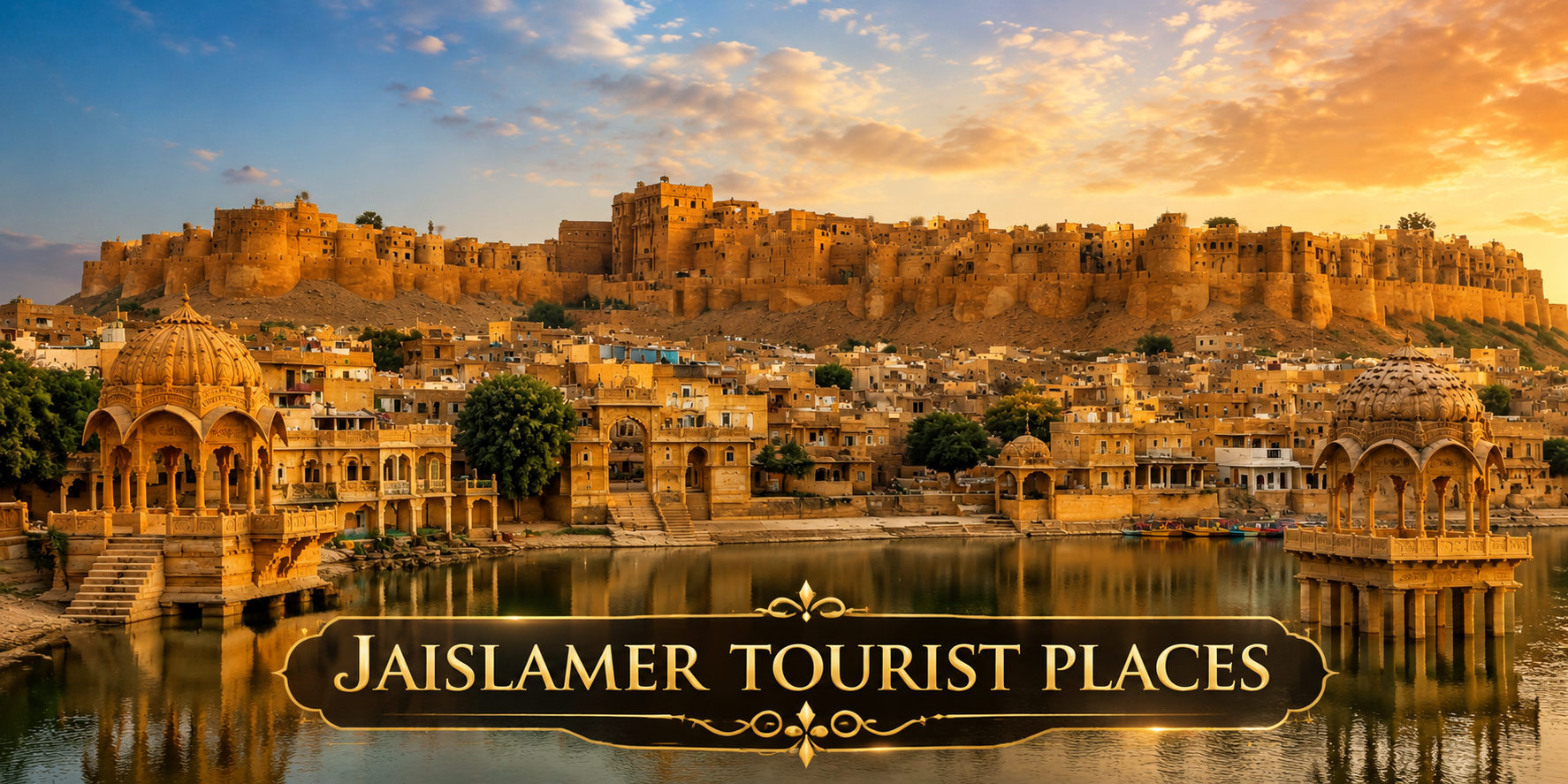
Jaisalmer Tourist Places, Desert Safari and Camp Guide
Jaisalmer works best as two linked days: one for the fort, Jain temples, havelis and Gadisar Lake, and one for the Thar. These main Jaisalmer tourist places fit together without a race. Leave after lunch for sunset, then either stay at a carefully checked camp or return to the city after dinner. Sam offers the widest choice and the liveliest evening; Khuri can feel slower, though neither is automatically quiet.
A Jaisalmer desert safari may be a 20-minute camel loop, a jeep ride, an evening package or an overnight trip. Compare the actual activity time, transfers, group size and meals rather than the package name. If a Jaisalmer desert camp is included, confirm the exact tent, bathroom, noise level, taxes and return plan before payment.
Choose your Jaisalmer desert safari in 60 seconds
| Experience | Indicative total duration (operator-dependent) | Best for | Confirm before booking |
|---|---|---|---|
| Short camel ride | 20–60 minutes | A first taste with limited time | Minutes on the camel, route, handler and return point |
| Sunset camel safari | 1.5–3 hours | A slower desert experience | Transfer to the start, riding time, group size and sunset stop |
| Jeep safari | 30–90 minutes | Covering more ground and controlled adventure | Vehicle, route, seats, driving style and passenger limit |
| Evening camp package | 5–7 hours from city pickup | Safari, show and dinner without a night stay | Transfers, activities, snacks, dinner and hotel-return time |
| Overnight desert camp | 18–24 hours | Convenience, sunrise and a tented stay | Exact tent, bathroom, meals, safari duration, taxes and checkout |
| Remote or open-sky overnight | 18–30 hours | Small groups seeking less infrastructure and more quiet | Land access, guide, bedding, toilet plan, weather cover and emergency vehicle |
The phrase “six-hour safari” may include two hours of road travel, a shopping stop, dinner and a stage show. Ask for the camel or jeep start and finish times separately. That one question exposes more than a large list of vague inclusions.
Rajasthan Tourism confirms camel and camel-cart safaris at Sam and Khuri and mentions jeep or dune-bashing experiences at Lakhmana and tracks near Sam and Khuri. This verifies the broad activity areas; it does not make every roadside seller, vehicle or route an official service.
15 best Jaisalmer tourist places and how to group them
The most useful way to organise Jaisalmer is by route, not by the length of an online attraction list. The fort, Jain temples and havelis form a city cluster. Kuldhara can fit a Sam-side desert afternoon when it is genuinely included. Desert National Park, Akal Wood Fossil Park, Tanot and Longewala need separate planning and should not be squeezed into a sunset package.
| Place or cluster | Route group | Suggested time allowance | Planning note |
|---|---|---|---|
| Jaisalmer Fort | City, mostly on foot | 1.5–2.5 hours | Go early; the lanes are lived-in, and palace-museum access is separate |
| Jain temples | Inside Jaisalmer Fort | 45–60 minutes | Fit the visit around current worship and visitor hours |
| Patwon Ki Haveli | Old-city cluster | 60–90 minutes | Allow time for carved exteriors, interiors and narrow lanes |
| Nathmal Ki Haveli | Old-city cluster | 30–45 minutes | Exterior details are the main draw; check current interior access |
| Salim Singh Ki Haveli | Old-city cluster | 30–45 minutes | Look for the distinctive upper storey and carved brackets |
| Gadisar Lake | City edge | 45–75 minutes | Works at sunrise or late afternoon; boating is a separate, changeable service |
| Bada Bagh | Outer city | 45–60 minutes plus travel | Royal cenotaphs and open views; carry sun protection |
| Vyas Chhatri | Short outer-city stop | 30–45 minutes | A compact sunset option; confirm the map pin and access |
| Kuldhara | Possible Sam-side safari stop | 45–60 minutes | Confirm the entry charge, stop length and whether it replaces desert time |
| Sam Sand Dunes | Desert half-day or overnight | At least 5–7 hours with city return | Largest choice of camps and activities; peak sunset is busy |
| Khuri Sand Dunes | Desert half-day or overnight | At least 5–7 hours with city return | Often slower in feel; exact crowd and facility levels vary |
| Desert National Park | Separate wildlife-focused excursion | Half or full day | Permissions, route knowledge and realistic wildlife expectations matter |
| Akal Wood Fossil Park | Separate route on the Barmer side | 1–2 hours plus travel | Good for geology; do not treat it as an automatic Sam-road stop |
| Jaisalmer War Museum | Jodhpur highway side | 60–90 minutes plus travel | Military-history stop; confirm current hours and security rules |
| Tanot Mata Temple and Longewala | Long road excursion | Most of a day | Check current access and identification requirements before departure |
Jaisalmer Fort and the Jain temples
Jaisalmer Fort, also called Sonar Quila, is a living neighbourhood rather than an empty monument. Homes, temples, shops and guest spaces still operate inside its walls. UNESCO lists it as one component of the serial World Heritage property, the Hill Forts of Rajasthan, and specifically notes its inhabited township and group of Jain temples.
Start early and walk slowly. The lanes are residential, so keep doorways clear, request permission before photographing people and carry as little disposable plastic as possible. The Jain temples deserve time of their own, but visitor access works around worship. Check the current local schedule instead of relying on one generic “fort opening time” for the entire complex.
Patwon, Nathmal and Salim Singh havelis
Patwon Ki Haveli is the strongest single haveli stop for many first-time visitors because there is enough detail to reward a proper look. Nathmal Ki Haveli and Salim Singh Ki Haveli add different facades and stories. Trying to complete every interior, however, can turn a good city walk into a queue of ticket counters.
Choose one main interior, view the others at a comfortable pace and allow for the narrow lanes between them. Confirm which section a ticket covers and whether photography or guide charges are separate. These havelis pair naturally with the fort; they do not need to consume the desert afternoon.
Gadisar Lake
Gadisar Lake is a useful, unhurried bookend to the old-city route. Early morning is calm, while late afternoon gives softer light but can be busier. Boating, if operating, is optional; the gateways, waterside view and short walk are enough for travellers who prefer to keep the visit simple.
Do not build a tight connection around a promised boat ride because hours and availability can change. Keep food away from the water, use the bins provided and leave enough road time if the lake is your final stop before a train or desert pickup.
Bada Bagh and Vyas Chhatri
Rajasthan Tourism places Bada Bagh about 6 kilometres north of Jaisalmer. Its cenotaphs and open setting work best as a dedicated sunrise or late-afternoon outing. Vyas Chhatri is the more compact option when the schedule allows only a short outer-city sunset stop.
Both places need respectful behaviour: these are memorial settings, not climbing frames for photographs. Shade is limited, and sunset plans should include enough time for the return rather than ending with an improvised roadside search for transport.
Kuldhara on the road to the desert
Kuldhara lies about 18 kilometres from Jaisalmer and can fit a Sam-side desert afternoon. Its abandoned lanes are atmospheric, but the familiar curse-and-disappearance tale is folklore, not a settled historical fact. A careful guide will distinguish what is documented from what is part of the local story.
Confirm the stop length before booking. Some packages list Kuldhara while allowing little more than a hurried photograph, and a long detour can quietly reduce the promised safari time. Entry, parking and guide costs should appear in the quote before the vehicle leaves Jaisalmer.
Sam Sand Dunes
Sam has the broadest choice of camel rides, jeeps, evening programmes and desert camps. That convenience makes it easy for a first visit, especially when travellers want transfers and several activities in one package. It also makes the main sunset points busy during the winter season.
A Sam address does not prove that a camp sits on open dunes. Request the property name and map pin, then compare drive time to the activity point, stage noise, tent spacing and the after-dinner return. Travellers who want atmosphere may enjoy the energy; those expecting silence need a more specific location check.
Khuri Sand Dunes
Khuri often feels slower and has fewer large-format facilities than Sam, which can suit travellers who value a village-side route or a simpler evening. It is still a known visitor area, so the name alone does not guarantee empty dunes or an intimate camp.
Check the same details you would at Sam: the actual riding point, transfer time, room or tent, bathroom, meal plan, entertainment and late-night noise. A well-run Khuri stay can be peaceful; a vague listing can be just as disappointing as a vague listing anywhere else.
Desert National Park
The Rajasthan Forest Department describes the protected area as Desert National Park Sanctuary, notified in 1980 across 3,162 square kilometres of Jaisalmer and Barmer. Its flagship species is the critically endangered Great Indian Bustard.
A wildlife visit is a separate experience from recreational dune bashing. It needs an appropriate route, permissions where required, a guide who understands the habitat and realistic expectations about sightings. Stay on permitted tracks, keep distance from birds and never use playback, food or vehicle chasing to force an encounter. For a wider wildlife route, compare the adventure and wildlife tours, the guide to national parks in India and the dedicated bird-watching tour.
Akal Wood Fossil Park
Akal Wood Fossil Park, roughly 17 kilometres from Jaisalmer on the Barmer side, is for travellers interested in the landscape beneath the postcard image. The fossilised wood and geological setting explain a much older desert story, and the stop works better with a curious guide than as a rushed photo call.
It is not an automatic stop on the Sam route. Plan the road direction deliberately, carry water and sun protection, and confirm current opening and entry arrangements locally before making it the anchor of a short day.
Jaisalmer War Museum, Tanot and Longewala
Jaisalmer War Museum is the easiest military-history stop to add because it is on the Jodhpur highway side of the city. Tanot Mata Temple and Longewala are a much longer road excursion and should receive most of a day rather than being attached to a sunset safari.
Road access, identification checks, photography rules and visiting hours can change in this border region. Confirm them shortly before departure, start with enough fuel and daylight, and keep the desert camp for another day. A long checklist is less useful than a route that can actually be completed without rushing.
Jaisalmer desert safari price in 2026
There is no single published government tariff that every private safari or camp must follow. A price becomes meaningful only after the unit is clear: per person, per camel, per jeep, per tent, per room or per couple. Get the full figure in writing, including GST and transfers, before comparing it with another quote.
RTDC Sam Dhani benchmark
The government-run RTDC Sam Dhani tariff, checked on 4 August 2026, is a useful public benchmark. It is not an official market rate and it does not predict what a private operator must charge.
| 2026 period | Listed double rate | Plan note on RTDC page |
|---|---|---|
| 1 Jan–31 Mar | AC ₹4,750; non-AC or Swiss tent ₹4,000 | MAP: room, breakfast and either lunch or dinner; GST extra |
| 1 Apr–30 Sep | AC ₹2,750; non-AC ₹1,500; no Swiss-tent tariff listed | CP: room and breakfast; GST extra |
| 1 Oct–1 Nov and 11 Nov–23 Dec | AC ₹4,750; non-AC or Swiss tent ₹4,000 | MAP plus camel safari and cultural programme; GST extra |
| 2–10 Nov, Diwali period | AC ₹5,750; non-AC or Swiss tent ₹5,000 | AP with all three meals, camel safari and cultural programme; GST extra; no discount applicable |
| 24 Dec 2026–2 Jan 2027 | AC ₹5,750; non-AC or Swiss tent ₹5,000 | AP, camel safari and cultural programme; GST extra; no discount applicable |
These are double-occupancy room or tent rates for the stated dates, not per-person safari tickets. For 1 October–1 November and 11 November–23 December, RTDC defines MAP as room, breakfast and either lunch or dinner; it also lists a camel safari and cultural programme. RTDC says fully decorated tents are pitched seasonally from September to March. Recheck the live tariff before publication or booking.
Planning ranges, not fixed tariffs
| Experience | Indicative editorial budget—verify a live quote | Why the quote moves |
|---|---|---|
| Brief shared camel activity | ₹500–₹1,200 per person | Ride time, location and transfer are often limited |
| Shared sunset camel/jeep combination | ₹850–₹2,500 per person | Actual time in each activity and pickup arrangement |
| Evening camp with dinner and show | ₹1,500–₹3,500 per person | Transfer, safari, meal quality and group size |
| Standard overnight camp | ₹3,000–₹7,000 per couple or room | Season, tent, bathroom, meals and activity inclusions |
| Private or remote overnight | ₹3,500–₹8,000+ per person | Small-group transport, staff, bedding and sanitation logistics |
| Luxury-labelled tent or suite | No dependable generic price floor | “Luxury” is not a standard category; compare the exact room, inclusions, property and dates |
These bands are rough editorial budgeting estimates, not RTDC tariffs, a systematic market survey or guaranteed Colours India Tours rates. Verify every figure against dated, itemised quotes before publication or booking; holiday and festival periods may cost more.
Before accepting a quote, ask:
- What is the charging unit, and how many people share the camel, jeep, transfer and tent?
- Which hotel pickup and return are included, in what vehicle and at what time?
- How many minutes are actually spent on the camel or dunes?
- Which meals and drinks are included?
- What exact tent category, bed and bathroom will be supplied?
- Are GST, entry fees, driver allowance and festive supplements included?
- What is the deposit, balance method and written cancellation policy?
- What happens if weather, local restrictions or low participation cancel an activity?
Camel safari or jeep safari?
A camel safari is slower, quieter and closer to the pace traditionally associated with desert travel. A jeep covers more ground and is easier for some travellers, but “jeep safari” can mean anything from a scenic track drive to forceful dune bashing. Neither is automatically better.
What a camel ride feels like
The biggest surprise comes at the start and finish. A camel rises and lowers in stages, which tips the rider sharply. Hold the saddle grip, follow the handler’s instruction and keep loose items secured. Longer rides can strain the hips, knees and lower back even when the pace is gentle.
People with back, hip, knee or balance concerns, and pregnant travellers, should seek appropriate medical advice and discuss alternatives with the operator. Walking beside the camel or using a calm vehicle transfer is a valid choice.
Check the animal before riding. Decline a camel with open wounds, obvious lameness, very poor body condition or badly fitting tack. Do not accept overloading, and ask whether the owner receives payment directly and the animals receive rest and water. A responsible handler will not punish the animal or pressure an uncomfortable guest.
How to judge a jeep experience
Ask for the vehicle registration, passenger limit, seat arrangement, driver experience and emergency procedure. Tell the driver your comfort level before departure. “No hard dune bashing” is a clear instruction, not an apology.
Small children, pregnant travellers and people with neck or back conditions should avoid aggressive driving. Repeated off-track runs can also damage fragile desert surfaces. Speed is not proof of a better safari; a controlled route with time to stop and understand the landscape often gives more value.
How to choose a Jaisalmer desert camp
A camp photograph normally shows the best tent in ideal light. It may not show the category being sold, the stage next door, the generator behind the bathroom or the road beside the property. Ask for a recent video of the exact room type and the name and map pin of the property before paying.
| Camp style | What it usually means | Check carefully | Best suited to |
|---|---|---|---|
| Evening-only camp | Activity, show and meal without a room | Seating, toilets, return transfer and meal timing | Travellers who prefer a city hotel |
| Standard Swiss tent | Canvas room, commonly with an attached bathroom | Hot water, winter bedding, power hours, locks and tent gaps | Value-focused one-night stays |
| AC tent or cottage | More solid construction or climate control | Whether AC/heating works all night and backup power | Families and comfort-focused guests |
| Luxury or boutique camp | Marketing category with no uniform standard | Real room size, privacy, dining plan and distance from actual dunes | Special trips and travellers who value property quality |
| Open-sky or mobile camp | Basic bedding or temporary tents away from large properties | Weather shelter, toilets, land access, security and evacuation vehicle | Experienced travellers comfortable with limited facilities |
What is usually included, and what may cost extra
A package may include a welcome drink, short camel ride, tea and snacks, cultural programme, buffet dinner, tent and breakfast. Jeep safari, city transfers, monument stops, premium seating, bottled drinks, heater, child bed and GST may still be extra.
Request a line-by-line inclusion sheet covering:
- Pickup point, vehicle type and return or onward transfer.
- Camel and jeep duration, whether private or shared, and passenger count.
- Exact tent or cottage name, bed setup and attached or shared bathroom.
- Hot-water hours, electricity, charging sockets, heating or air-conditioning.
- Tea, snacks, dinner, breakfast, drinking water and dietary requirements.
- Performance start and finish, seating and whether music continues late.
- Taxes, entry fees, festive supplements, child policy and extra-bed charge.
- Check-in, checkout, cancellation, weather policy and emergency contact.
Light sleepers should request a tent away from the performance stage, kitchen, parking and generator. Families should ask about open fires, vehicle movement, boundary fencing and night security. Travellers with limited mobility need photographs of the path, bathroom threshold and dining access, not only a promise that the camp is “senior friendly”.
For a date-specific comparison, send Colours India Tours the travel dates, group size, preferred area, activity and room standard. A useful reply should name the property and show the transfer, actual safari time, room category, meals, taxes and cancellation terms in one quote.
Sam Sand Dunes vs Khuri vs remote dunes
| Area | Typical character | Advantages | Trade-offs |
|---|---|---|---|
| Sam | Busy, established and activity-led | More camps, transport choices, shows and short activities | Crowds, traffic, sellers and amplified music at peak times |
| Khuri | Often slower and more village-oriented | Fewer large properties and a calmer feel in some locations | Fewer facilities and no guarantee of solitude at sunset |
| Remote or “non-touristic” | Provider-dependent, small-scale and less serviced | Potentially quieter with darker skies | Greater responsibility for land access, sanitation, communication and rescue |
Sam is commonly described as roughly 40 kilometres from Jaisalmer, while Khuri is farther for many city pickups. Treat those as broad planning figures: the hotel, road, camp gate and actual riding point all affect transfer time.
“Khuri is quiet” and “Sam is commercial” are tendencies, not rules. A small Sam-side camp can be calmer than a busy Khuri sunset point. Ask exactly where the activity begins, how many groups are expected and whether the tent sits beside the performance area or away from it.
A secret location is not a safety plan. For a remote overnight, ask who permits use of the land, how toilet waste and food waste leave the site, what weather shelter is carried, whether mobile coverage exists and which vehicle remains available. Do not publish or share a sensitive wildlife or community site merely to prove that it is secluded.
Jaisalmer itinerary for 1, 2 or 3 days
One day: city highlights and evening desert
Start early at Jaisalmer Fort and its Jain temples, continue to Patwon Ki Haveli, then have lunch and a short rest. Leave for the desert in mid-afternoon for the chosen camel or jeep activity, sunset, dinner and a pre-arranged return to Jaisalmer.
This is possible but compressed. Skip extra roadside stops and an overnight camp. If your train or flight arrives late, choose either the city or the desert rather than racing through both.
Two days: the balanced first visit
Day 1: Explore the fort early, including the Jain temples according to current visitor hours. Walk through the old city to Patwon Ki Haveli. Use late afternoon for Gadisar Lake or Bada Bagh, then sleep in the city.
Day 2: Keep the morning for a remaining haveli, a market walk or rest. After lunch, leave for the desert. Include Kuldhara only if the stop length, fee and route are clear. Complete the safari, watch sunset and attend the cultural programme. Stay in a pre-checked camp or return to the city with the same written transfer plan.
Three days: add depth without stacking the route
Follow the two-day plan and use the third day for one proper excursion: Desert National Park with an appropriate guide, Akal Wood Fossil Park, or the Tanot–Longewala road after confirming current access. Another good option is simply a slower city morning after the camp rather than a pre-dawn checkout followed by hours in a vehicle.
Jodhpur is the natural onward city for many Rajasthan routes. The Jodhpur tourist places guide helps decide whether to allow one day or two there, while the Rajasthan heritage tour packages connect the larger route.
Best time and realistic safari timings
October to March is the main and most comfortable camping period identified by Rajasthan Tourism. November to February brings cooler days and cold nights; December and January can require a proper warm layer after sunset. October and March are usually warmer but still more manageable than summer.
April to June can bring severe daytime heat. Some operators may sell limited activities, but a midday ride or open jeep is unsuitable for many travellers. July to September brings irregular monsoon conditions, heat and humidity, and some seasonal camps may not operate. Confirm the property, not just the booking agent.
A typical sunset programme leaves Jaisalmer in early or mid-afternoon and returns after dinner. Morning departures cluster around sunrise, while an overnight trip commonly returns after breakfast. Exact times must move with the season.
Ask the operator to write down:
- Hotel pickup and arrival at the activity point.
- Actual camel or jeep start and finish.
- Sunset stop and transfer to camp.
- Cultural programme, dinner and return departure.
- Expected hotel arrival or next-morning checkout.
Holiday weeks and the Jaisalmer Desert Festival need earlier reservations, but festival dates and programmes can change. Confirm them on the official Rajasthan Tourism site before buying non-refundable transport.
Safety, welfare and responsible desert travel
Families, solo travellers and night travel
Share the operator name, vehicle number, camp pin and expected return with someone outside the group. Download an offline map. Mobile coverage can weaken away from the main roads, and a brand name on a booking message does not replace a traceable office, written terms and a working local contact.
Solo travellers should avoid last-minute roadside deals and ask about the group composition, room lock, night staff, bathroom access and return vehicle. Women travelling alone may also want to know whether women staff are present at the property.
Families need age-appropriate activities and supervision. A small child should not ride alone simply for a photograph. Ask for the road vehicle’s child-seat arrangement, keep children away from camel legs and open fires, and decline high-speed dune driving. Older travellers may find the camel’s mounting movement harder than the ride itself.
Water, toilets and waste
An attached bathroom does not prove that sewage is treated responsibly. Ask whether the toilet is fixed, portable or a leave-no-trace arrangement and how waste is removed. For an open-sky camp, the answer should be more detailed than “the desert is empty”.
Water is scarce. Keep showers short, decline unnecessary linen changes and use safe refill stations where the operator can explain filtration. Carry one sealed emergency bottle, but take plastic, wet wipes and cigarette ends back out with you.
Cultural programmes and local livelihoods
Many camps include folk music and dance, but quality and working conditions differ. Ask whether performers are contracted directly and whether tips reach them. Keep bright lights out of performers’ faces, do not enter the performance area unless invited and do not treat musicians as decoration for dinner.
A smaller, fairly paid music session can be more meaningful than a large stage. The same principle applies to camel owners, guides, drivers and cooks: transparent direct payment strengthens the local value of the trip.
What to pack
Carry sun protection, closed shoes, a scarf or buff, lip balm, a reusable water bottle and a warm evening layer. Sand enters open footwear and camera equipment, so keep batteries and lenses sealed when not in use. A headlamp is useful between tents; point it toward the ground.
Bring essential medication because the nearest pharmacy may be far away. For basic camping, ask what bedding and weather cover are supplied instead of assuming. Avoid a bag full of disposable wipes and miniature toiletries that will become desert waste after one night.
Common booking traps
The cheapest headline often excludes the transfer that makes the activity possible. “Camel safari included” may mean a short circle near the parking area. “Private camp” may describe the tent while the safari, dinner and show remain shared with several bus groups.
Other warning signs include:
- No written cancellation or weather policy.
- Payment requested to an unrelated personal account without a receipt.
- Refusal to name or pin the camp before pickup.
- Stock photographs appearing across several unrelated properties.
- A jeep with unclear registration, seating or passenger limit.
- A guide who prevents direct confirmation with the camp.
- Commission-shopping stops that were never requested.
Pay a reasonable, traceable deposit and connect the balance to delivery of the agreed service. Save the inclusion sheet offline. If a last-minute “upgrade” changes the property, ask for the new name, map pin and room video before accepting.
Jaisalmer safari, camp and sightseeing FAQs
What is the Jaisalmer desert safari price?
There is no single official price. A brief shared activity may cost hundreds of rupees per person, while private and overnight packages cost several thousand per person, room or tent. Compare the unit, activity time, transfers, meals, accommodation, taxes and group size.
What is included in a Jaisalmer desert safari?
Possible inclusions are city transfers, camel ride, jeep drive, sunset stop, snacks, cultural programme, dinner, tent and breakfast. Nothing should be assumed from the word “package”; request each inclusion in writing.
Which is better, camel safari or jeep safari?
A camel safari is slower and quieter but can be physically demanding. A jeep covers more ground and can suit travellers who do not want to ride, provided it is driven responsibly. Choose according to health, pace, animal-welfare preference and desired route.
Is Sam or Khuri better?
Sam offers more camps, activities and a lively atmosphere. Khuri often feels slower and has fewer large facilities, but it is not automatically empty. The exact operator, activity point and camp location matter more than the label.
Is one night in a Jaisalmer desert camp enough?
Yes for most first-time visitors. One night allows sunset, dinner, a cultural programme and sunrise without taking too much time from Jaisalmer city. A second night suits travellers choosing a deeper camel, wildlife or village-focused route.
Can I visit the desert and return to Jaisalmer the same night?
Yes. Many evening packages include or can arrange return after dinner. Confirm the vehicle, departure time, driver contact and hotel drop in writing, especially with children, older travellers or a late arrival.
What is the best time for a Jaisalmer desert safari?
October to March is the main season. November to February has the coolest weather and cold nights, while October and March are warmer. April to June can be severely hot, and seasonal camps may reduce operations outside winter.
How many days are enough for Jaisalmer tourist places and a safari?
Two days are enough for the main fort-and-haveli cluster plus a desert afternoon and evening. Three days allow an overnight camp and one unhurried excursion. A single day is possible but compressed.
Is a Jaisalmer desert safari safe for families?
It can be when the provider uses a maintained vehicle, suitable animals, supervised activities, clear routes and an emergency plan. Avoid aggressive dune driving with small children and ask about fires, railings, locks, bathrooms and night staffing at the camp.
Is Desert National Park the same as a sand-dune safari?
No. Desert National Park is a protected arid ecosystem and wildlife-focused visit. It requires appropriate routes and realistic expectations. A recreational camel ride or dune-bashing package at Sam or Khuri is a different product.
Choose clarity before a discount
The best safari is not the one with the longest inclusion list. It is the one that delivers the promised activity time, safe transport, suitable camp and clear return. Decide first whether the priority is a camel journey, jeep drive, cultural evening, quiet night or comfortable tent; then pay for that specific experience.
To connect Jaisalmer with the rest of Rajasthan, use the Rajasthan taxi rental service and heritage routes above. For an itemised safari or camp proposal, contact Colours India Tours with the dates, adult and child count, preferred activity, room standard and whether the group wants to stay overnight or return to the city.