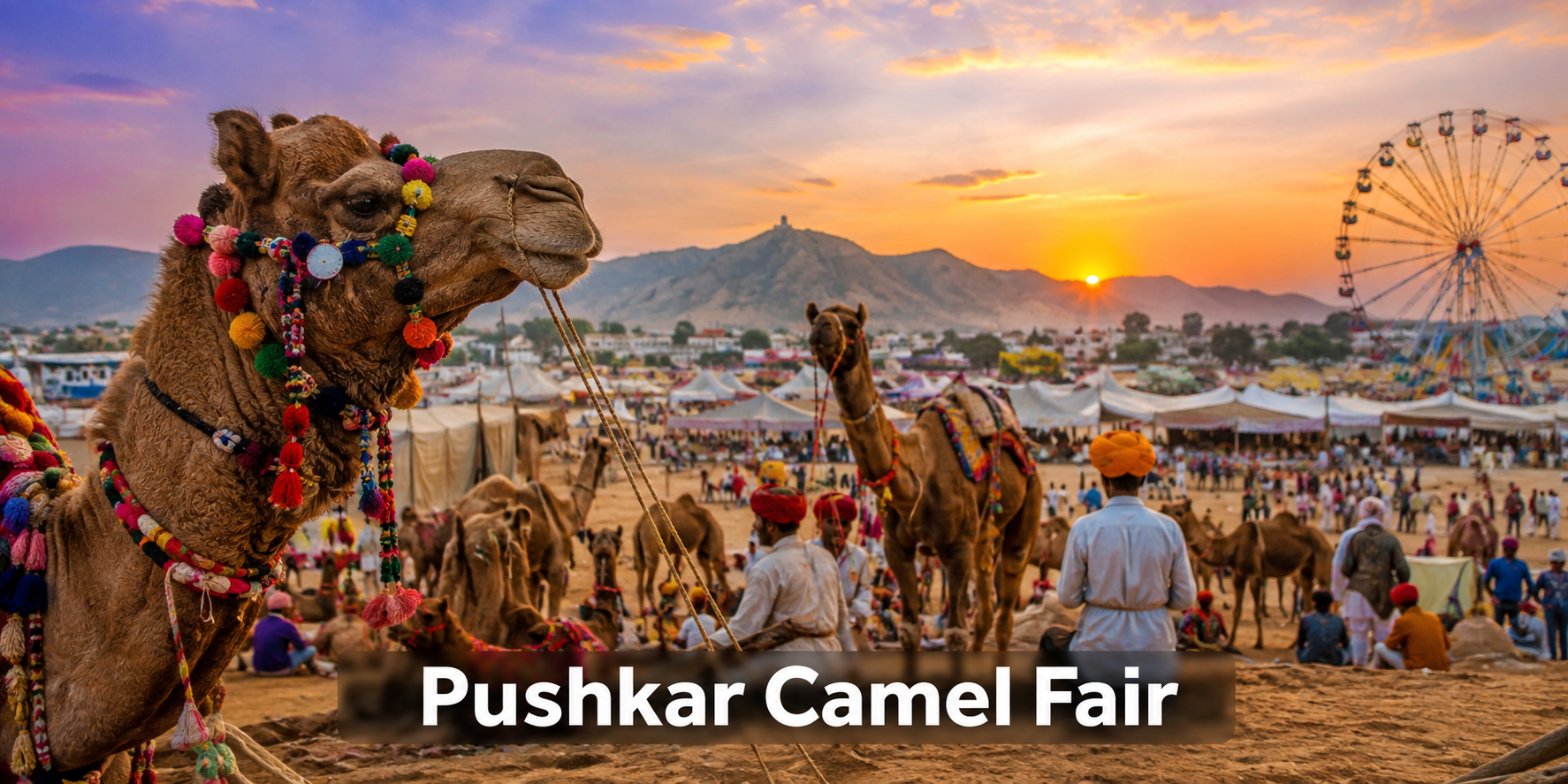
Pushkar Camel Fair 2026: Dates, Events & Visitor Guide
Pushkar is one town before breakfast and another by lunch. Out on the sand, owners are feeding camels, checking horses and talking business while most hotel guests are still looking for coffee. A few hours later the stages have woken up, visitors are streaming in and the lanes around Pushkar Lake are thick with pilgrims.
It is all the same fair. It does not always feel that way.
Circle 17–24 November for the 2026 Pushkar Camel Fair; that is the range in Rajasthan Tourism’s current calendar. Useful, yes. But it does not mean every camel, contest and ceremony waits patiently inside those eight boxes. Owners come and go according to business, while the religious side gathers pace as the full-moon period approaches.
Two nights will give you one proper day. Three nights are kinder, especially if sunrise photography and the ghats both matter.
Pushkar Camel Fair 2026: the useful facts
| Planning point | 2026 details |
|---|---|
| Official dates | 17–24 November 2026 |
| Place | Pushkar, Ajmer district, Rajasthan |
| Main areas | Fairground on the edge of town; lake and old-town ghats |
| Useful rail station | Ajmer Junction |
| Major airport | Jaipur International Airport |
| Comfortable trip | 2–3 nights |
| November weather | Pleasant days, cooler mornings and nights |
| Booking approach | Reserve early; reconfirm the daily programme later |
The dates are confirmed in Rajasthan Tourism’s official fairs and festivals calendar. At the time of writing, the detailed day-by-day programme has not been treated here as fixed. Check the official Pushkar Fair page again shortly before travelling.
Dates look neat. Fairs rarely are.
Why the fair can feel like two different events
Its roots are practical and spiritual. Pushkar was a place to buy and sell livestock, and Kartik Purnima gave the lake deep religious importance at the same time. Owners brought camels and horses; pilgrims came for the water and temples. Stages, contests, craft stalls, temporary camps and visitor activities grew around those older reasons for being here.
The English name can be misleading. Camels remain its defining image, but this is not an eight-day camel parade waiting for spectators to arrive. Numbers rise and fall as deals are made. Horses may be just as noticeable on a given morning, while the old town follows a separate rhythm of temple visits, ceremonies and pilgrims moving towards the water.
That difference matters. The fairground is a place of work; the ghats are places of worship. Neither was built as a photo set.
Pick a side of the fair before picking a date
There is no universal “best day”. Someone hoping to photograph animals at dawn wants a different Pushkar from a pilgrim coming for the full-moon rituals, and both will have a poor trip if they copy the same itinerary.
Early days: more trade, fewer guarantees
The opening stretch usually makes the most sense for livestock, camp life and the feeling of a trading ground taking shape. Some owners may arrive before the official programme; others leave once business is done. A closing ceremony does not automatically mean the largest gathering of camels.
Middle days: the easiest first visit
This part of the week can offer a useful mix of animals, tourism events and ordinary town life. It also gives you room to move a sunrise session if weather, traffic or simple tiredness gets in the way.
The final phase: Pushkar turns towards the lake
Come late in the fair if the Kartik Purnima period and the religious character of Pushkar are the point of the trip. Expect tighter streets, more pilgrims and greater pressure on transport. Around the ghats, patience is not optional.
Camels do not perform on a timetable
Rajasthan Tourism programmes have previously featured folk music, dance, rural games, decorated animals and contests associated with turbans or moustaches. The categories may return; a particular event at a particular hour should not be treated as certain until the 2026 programme appears.
Choose one or two scheduled events, not seven. The unscripted fairground is usually more interesting than a frantic march between stages.
On the livestock ground
Sunrise and late afternoon bring softer light and cooler air. Owners feed animals, check tack and talk business. Keep out of working paths, leave an escape route around horses and never stand directly behind an animal for a better angle.
Want a close portrait? Ask. If somebody deliberately poses or gives time, a modest tip may be appropriate, but the agreement comes before the photograph. A guide cannot quietly grant consent on another person’s behalf.
Stages, competitions and the occasional muddle
Public performances may take place on government stages or inside private camps. Find out whether the programme is free, separately ticketed or bundled into a stay. Get there early if seating matters; a phone held above your head improves nobody else’s evening.
Competition times are particularly slippery. Find the tourism information desk once you arrive and ask again that morning. The screenshot saved three weeks ago has already done enough.
The market rewards a second look
The temporary market is a jumble of textiles, jewellery, leatherwork, ornaments and quick souvenirs. You will find local work. You will also find stock that has travelled farther than you have. Ask where a piece was made, inspect the finishing and get a receipt before spending serious money.
The lake is not the quiet half of the trip
Pushkar Lake is sacred, and the fair coincides with an important pilgrimage period. Shoes come off where requested. Clothing should cover shoulders and knees, voices drop near ceremonies and cameras stay away from people bathing or praying unless consent is unmistakable.
A priest may offer a ritual. Before saying yes, ask two plain questions: what happens, and what donation is expected? Entry to a public ghat does not require the large “compulsory” payment sometimes demanded from newcomers. Decline, keep walking and head for tourist police or an official desk if the pressure follows you.
Sometimes the respectful photograph is no photograph at all.
Three days without chasing everything
Day one: learn the shape of the town
Arrive by early afternoon and check in before the roads become busier. Walk the route between your hotel, the lake and the fairground while there is daylight. Then find the official information point and photograph the current programme board.
Spend the final light on the fairground. Activity often picks up as the heat fades, and the return walk is far less confusing when the lanes are still familiar. Dinner can wait until you are back in town.
Day two: an early alarm, followed by a long pause
Meet a guide or companion before sunrise at an agreed public point. The aim is not merely good light; it is reaching the right section without crossing animal lines or wandering into a private camp. Go back for breakfast afterwards.
Rest.
One or two midday events are plenty. Use the later afternoon for the Brahma Temple area, old-town lanes and markets, then approach the lake towards evening with the local rules in mind.
Day three: return to what held your attention
There is no prize for equal coverage. Photographers may want a second morning with the animals; travellers drawn to Pushkar’s religious history may prefer the temples and ghats. Leave a generous transport buffer when departing. Festival traffic can turn a short transfer into the most anxious part of the trip.
Getting to Pushkar is easy. Timing it is not.
Ajmer sits close—roughly 15 kilometres away—and its junction is the useful railhead. From there, travellers continue by taxi, bus or auto-rickshaw, depending on whatever crowd controls are in force. Central Pushkar may close to through traffic, so ask for the real drop-off point rather than the optimistic one printed on a booking voucher.
Jaipur is the nearest major air gateway. The drive takes several hours in normal conditions and longer once the fair starts bending traffic around Pushkar. A fixed performance shortly after arrival is a poor bet.
For a private journey, compare the Rajasthan taxi-rental service or Jaipur car-rental options. Put the drop-off point, parking, waiting allowance and late-night charge in writing before setting out.
Is a Pushkar day trip from Jaipur sensible?
Possible, yes. Pleasant, not always. The long return drive can force day visitors to miss the strongest morning activity and leave just as the evening begins to settle.
If one day is all you have, leave Jaipur before dawn, choose a single priority and agree on an exact return meeting point. Do not put an evening flight or important train immediately afterwards. One night in Pushkar or Ajmer buys far more than a bed; it removes the clock from the fairground.
A tent called “luxury” may still be cold
Accommodation falls into three rough groups: hotels and guesthouses in Pushkar, temporary fair camps, and conventional stays in Ajmer or beyond the busiest roads. Each solves one problem and creates another.
Inside Pushkar town
Staying in town puts restaurants, the lake and much of the fair within walking distance. It also brings noise, stairs, narrow lanes and awkward vehicle pickups. Ask for the exact map location, whether the room faces an event space, and how hot water or generator backup works when occupancy is full.
At a temporary camp
Camps can bundle meals, transfers and cultural evenings into one convenient price. Standards vary wildly. Request recent photographs of the exact tent category, then ask about the bathroom, night security, fire precautions, bedding, heating and distance from the public fairground.
“Luxury tent” is marketing, not a building standard.
Over in Ajmer
Ajmer offers more conventional hotels and easier access to the railway station. Daily travel is the trade-off. Confirm whether a shuttle exists, where it stops and what happens if road restrictions move that stop.
Book early, but do not let scarcity push you into an untraceable bank transfer. Get a written confirmation showing taxes, meals, transfers and cancellation terms.
Pack for dust, cold mornings and crowded hands
November afternoons are usually agreeable. Dawn on exposed ground is another matter; so is the walk home after dark. Pack a light layer and scarf alongside the sunscreen, lip balm and closed shoes. When the wind gets up, a simple breathable face covering is worth far more than it weighs.
Keep that bag small.
A power bank helps when charging points and mobile networks are under pressure. After dark, point a torch at the ground—not into somebody’s face or a camel’s eyes. Keep an identity-document copy away from the original, just in case.
A camera does not cancel consent
The fair is intensely photogenic, which is precisely when manners tend to wobble. For a close portrait, lower the camera and ask the person first. Be especially careful around children, women, priests and anybody trying to work. Sweets or cash offered to a child for a picture are not a harmless shortcut.
A longer lens lets animals keep their space. If getting the shot requires someone to prod a camel into standing, running or turning, let the shot go. Drone rules may be strict or flying may be banned altogether; crowds, security and nervous animals are reason enough.
Think before accepting a ride
Look at the animal first. Visible wounds, lameness, difficult breathing, poor tack or an operator using blows are reasons to walk away. Congested sunset rides can feel hurried anyway; an unmounted walk through the public ground may be the better experience.
If you choose a ride, settle the duration, route and total price before mounting. Ask whether the owner is paid directly. Thinking about a jeep instead? Pick a driver who stays on established tracks and does not confuse a dune outing with a speed trial.
Eat well, then keep the monkeys out of it
Pushkar’s identity as a Hindu pilgrimage town shapes what appears on the menu. Vegetarian cooking dominates; meat and alcohol are restricted or simply out of place near the sacred centre. Check the current law and your hotel’s policy instead of relying on what somebody got away with last year.
A busy kitchen often means ingredients are turning over. Order something cooked fresh, drink sealed or reliably filtered water and skip unsealed dairy if the storage gives you doubts. Hide snacks from monkeys.
They do not negotiate.
Rituals, donations, shopping and transport cause most of the uncomfortable exchanges. Ask the cost before accepting a thread, flower, blessing or ride. Buy through authorised counters where they exist. In dense crowds, move the zipped bag to the front and give your group a meeting point that still works when the phones do not.
For women travelling alone, a staffed reception and a well-lit walk back are worth checking before the room photos. Send the vehicle details to somebody you trust. Once the organised activity finishes, there is little reason to wander through an isolated stretch of fairground. India’s emergency number is 112; the hotel and driver numbers should also be saved offline.
Children, older travellers and the midday retreat
Families can enjoy the fair, but the usual sightseeing pace will not work. Sand, noise, crowds and uneven lanes tire people quickly. Plan one main outing in the morning and another late in the day, with a shamelessly long break between them.
Strollers struggle on the fairground. A carrier is often easier for a small child. Older travellers and anyone with reduced mobility should ask about steps, lift access and the nearest permitted vehicle point before paying for a room.
A useful guide knows when to step back
A good local guide explains which ground is used for trading, asks before portraits and keeps guests out of animal paths. They can also separate an official tourism event from something arranged by a private camp.
Before booking, ask for a full name, authorisation where applicable, working language, start and finish times, group size and total fee. Any commission from a shop, priest, camp or activity operator should be disclosed. Photographers often get more from a short sunrise walk plus a separate old-town visit than from an exhausting all-day escort.
Pushkar has not disappeared behind the fair
The lake, temples, Savitri Temple hill and villages around town deserve attention beyond the programme board. Check current ropeway or hill-route hours locally, especially if accessibility matters.
When the fair becomes too much, step away. A quiet café, an early meal or a short heritage walk is not wasted time; it is often what keeps the following morning enjoyable.
Pushkar Camel Fair questions travellers keep asking
What are the Pushkar Camel Fair 2026 dates?
Rajasthan Tourism lists the fair from 17 to 24 November 2026. Recheck the official daily programme shortly before travelling.
How many nights should I stay?
Two nights provide one full day. Three are better for a fairground sunrise, cultural events and time around the lake without turning the visit into a race.
Which day will have the most camels?
No date comes with that guarantee. Owners may arrive before the public programme and leave after trading. Early and middle dates often suit animal-focused visitors, but conditions change each year.
Do I need a ticket for the Pushkar Fair?
General access to parts of the town and fairground may be free. Particular shows, camps, rides, activities or viewing areas can charge separately, so ask before entering or accepting a service.
Can international tourists attend?
Yes. Visitors come from around the world. Sacred-area etiquette, traceable bookings and a little firmness around donation or shopping pressure make the experience easier.
What should women wear?
Loose clothing that covers the shoulders and knees is comfortable and respectful, particularly at temples and ghats. Closed shoes cope better with dust and uneven ground.
Can I visit from Jaipur in one day?
You can, but the return drive and fair traffic make it tiring. Leaving before dawn helps; staying at least one night gives the trip a calmer shape.
Decide what you came for
Livestock and photography. Cultural events. Pilgrimage. Perhaps a mixture, but probably not every hour of everything.
Choose dates that suit that priority, stay long enough for one plan to go wrong and keep the daily schedule loose. To build the fair into a wider trip, compare the India fairs and festival tours, browse Rajasthan cultural tours or contact Colours India Tours with your dates and preferred pace.