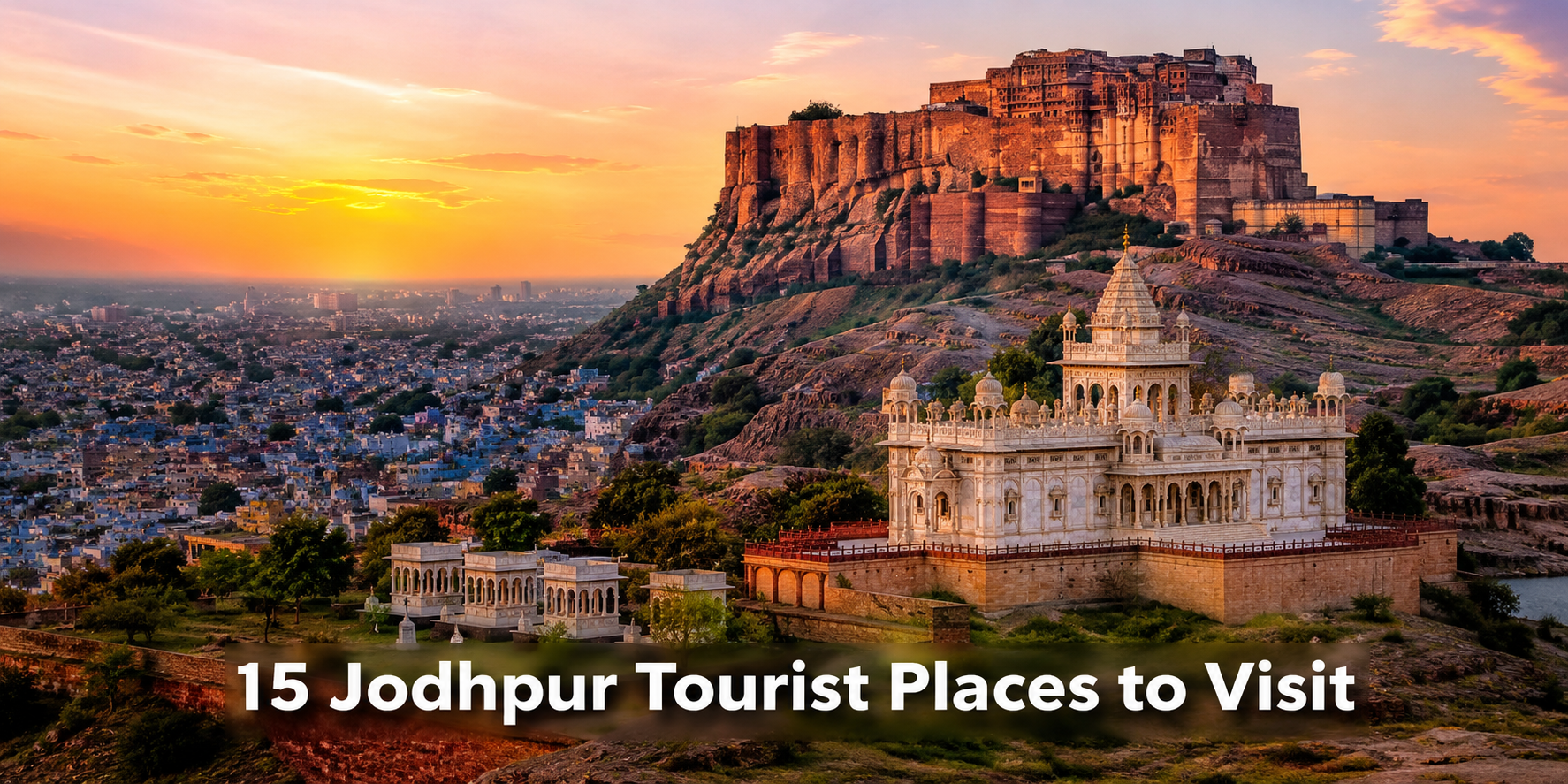
15 Jodhpur Tourist Places to Visit: 2-Day Blue City Guide
Jodhpur looks straightforward on a map. There is a huge fort, a patch of blue houses below it and a market around the Clock Tower. Easy. Then you arrive, discover that the old lanes twist uphill, the afternoon sun drains your energy and half the places on your list sit in completely different parts of the city.
A good Jodhpur trip is less about collecting attractions and more about grouping them properly. Spend one day around Mehrangarh and the old city. Use the next for Umaid Bhawan, Mandore and whichever lake, museum or rural experience genuinely interests you. That gives you time to stop, look and eat without turning the Blue City into a blur outside a car window.
This guide covers the best places to visit in Jodhpur, including current 2026 timings and ticket prices where official sources publish them. It also gives you realistic one-, two- and three-day plans. Start with Mehrangarh. Everything else can move around it.
Jodhpur tourist places list at a glance
| Place | Best for | Time needed | Best planning window |
|---|---|---|---|
| Mehrangarh Fort | History, palace rooms, city views | 2.5–3 hours | 9:00 am–5:00 pm; go at opening |
| Jaswant Thada | Marble architecture and a quiet break | 45–60 minutes | 9:00 am–5:00 pm |
| Rao Jodha Desert Rock Park | Walking, native plants and geology | 1.5–2 hours | Early morning |
| Blue City lanes | Neighbourhood walks and photography | 1.5–2 hours | Morning or late afternoon |
| Toorji ka Jhalra | Stepwell architecture | 30–45 minutes | Morning or evening |
| Clock Tower and Sardar Market | Food, textiles and street life | 1–2 hours | Late afternoon and evening |
| Umaid Bhawan Palace Museum | Modern royal history | 1–1.5 hours | Late morning or afternoon |
| Mandore Gardens | Cenotaphs and pre-Jodhpur history | 1.5–2 hours | Morning |
| Kaylana Lake | Open views and sunset | 45–75 minutes | Late afternoon |
| Machia Biological Park | Families and wildlife education | About 2 hours | Morning |
| Bishnoi village area | Rural crafts and community ecology | Half day | Morning |
| Balsamand Lake | Gardens and a slower outing | 1–1.5 hours | Late afternoon, if accessible |
| Sardar Government Museum | Regional history | About 1 hour | Midday |
| Masuria Hill | Wide city views | 45–60 minutes | Before sunset |
| Guda Bishnoiyan Lake | Birds and rural surroundings | 1–2 hours | Early morning |
If you have only one day, choose the first six places and do them well. Umaid Bhawan and Mandore deserve a second day. Lakes, the biological park and the Bishnoi area are optional choices, not obligations.
1. Mehrangarh Fort: the place to begin
Mehrangarh is not simply the biggest attraction in Jodhpur; it explains the city around it. The fort rises from a rocky ridge about 125 metres above the streets, and parts of its outer walls appear to grow directly from the stone. From the ramparts, the old city stops feeling confusing. You can see how the blue houses, markets, lakes and newer districts fit together.
Inside, the museum route moves through gates, courtyards, period rooms and galleries containing paintings, arms, textiles, royal furniture, palanquins and elephant howdahs. Sheesh Mahal, Phool Mahal, Moti Mahal and Takhat Vilas each have a different character. Do not rush straight to the view and skip the interiors.
The Mehrangarh Museum Trust currently lists opening hours of 9:00 am to 5:00 pm, daily. Tickets are ₹200 for domestic adults and ₹800 for international adults. Domestic student and senior tickets are ₹100; international student admission is ₹500. A one-way elevator costs extra, and ticket sales close at 5:00 pm.
Arrive when the gate opens and allow two and a half to three hours. The audio guide is useful, especially if you do not know much about Marwar history. Authorised human guides are also available, but agree on the fee and route before starting.
2. Jaswant Thada: close by, but a different mood
Jaswant Thada sits near Mehrangarh, so it is the obvious second stop. The white-marble memorial was commissioned by Maharaja Sardar Singh in memory of his father, Maharaja Jaswant Singh II, and was completed in 1906.
The atmosphere is calmer than the fort. Thin sections of polished marble pick up the changing light, while the grounds open toward the rocky ridge and fort walls. Inside, portraits help place Marwar’s rulers in sequence.
Current official hours are 9:00 am to 5:00 pm, every day. Admission is ₹50 for domestic visitors and ₹100 for international visitors. Forty-five minutes is enough for most people, though you may want longer if the weather is comfortable and the grounds are quiet.
3. Rao Jodha Desert Rock Park: the fort’s wild side
Rao Jodha Desert Rock Park is one of Jodhpur’s most rewarding stops, yet it is often cut from hurried itineraries. The park was created in 2006 to restore native ecology on rocky ground below Mehrangarh after an invasive shrub had taken over much of the area.
Trails cross volcanic rock and dry-country vegetation, with frequent views back toward the fort. This is where the harsh physical setting of Marwar becomes real. The visitor centre can recommend a short or long route based on heat, time and fitness.
Official seasonal hours are 7:00 am to 6:30 pm from April to September and 8:00 am to 5:30 pm from October to March. Entry is ₹100; students through Class 12 enter free with identification. A naturalist-led walk is available for an additional fee.
Wear closed shoes and carry water. In hot weather, come at opening or leave the park for another day. Combining a long trail with three hours inside Mehrangarh at noon is more exhausting than it sounds.
4. The Blue City lanes: homes, not a film set
The Blue City is not a gated attraction with one official entrance. Blue-painted houses appear through residential neighbourhoods below Mehrangarh, particularly around Navchokiya, Brahmapuri and nearby lanes.
Stories about the colour vary. Some connect it with Brahmin households, others with limewash, cooling or insect control. No one explanation accounts for every blue house or every period. What is certain is that the colour became part of Jodhpur’s visual identity.
A local guide is worth considering because the lanes turn sharply, climb unexpectedly and lead through private residential areas. Ask before photographing people, do not block doorways and never climb onto a roof because a social-media caption calls it a public viewpoint.
Morning brings softer light and less heat. If a self-guided walk makes you uncomfortable, include the neighbourhood in a broader itinerary through our Rajasthan heritage tour packages.
5. Toorji ka Jhalra: a stepwell in the middle of daily life
Toorji ka Jhalra is an eighteenth-century stepwell tucked into the old city. Flights of sandstone steps descend toward the water in a crisp geometric pattern. It is a compact stop, but it says a great deal about how an arid city stored water.
The area around it now has cafés, shops and restored buildings, so it is easy to combine with a meal or the Clock Tower. Go early if you want an uncluttered photograph. Evenings are livelier but busier.
Do not swim or jump into the water, regardless of what videos online show. Water quality, depth and submerged hazards are unpredictable. The stepwell is a heritage structure, not an adventure pool.
6. Clock Tower and Sardar Market: useful chaos
Ghanta Ghar, Jodhpur’s Clock Tower, anchors Sardar Market. The lanes around it sell spices, textiles, leather goods, household items, snacks and souvenirs. This is an operating market rather than a carefully staged visitor precinct. It can be noisy, crowded and genuinely fun.
Late afternoon works well because the heat softens while trading picks up. Keep your bag closed, watch for motorcycles and compare more than one shop before buying. For costly jewellery or fabric, ask what the material is and request a bill.
Mirchi bada, mawa kachori and makhaniya lassi are closely associated with Jodhpur. Choose a busy, clean stall with high turnover instead of relying only on a famous name. A long queue does not excuse poor food handling.
7. Umaid Bhawan Palace Museum: Jodhpur enters the twentieth century
Umaid Bhawan looks and feels completely different from Mehrangarh. Construction began under Maharaja Umaid Singh in 1929 during a period of drought and scarcity, creating a large public-works project while producing one of India’s best-known twentieth-century palaces.
The complex now contains a royal residence, a luxury hotel and a museum. A museum ticket does not give access to hotel areas or private residential spaces. This is the source of many disappointed reviews, so set your expectations correctly.
The museum covers the royal family and palace construction through photographs, objects and displays. Allow about an hour. Confirm the current weekly closure, admission and photography rules before leaving, because public access can change around official functions and private events.
8. Mandore Gardens: Jodhpur before Jodhpur
Mandore was the capital of Marwar before Rao Jodha founded Jodhpur in 1459. Its garden complex contains historic remains and tall red-sandstone cenotaphs that look more like temples than the restrained marble memorial at Jaswant Thada.
Give the site at least 90 minutes. Moving quickly between the biggest structures misses why Mandore matters: it connects the region’s history before and after the capital shifted to Jodhpur.
Come in the morning. The open garden gets hot, and monkeys can be aggressive around visible food. Keep snacks packed away and do not feed them. Museums or enclosed sections within the complex may follow different schedules from the main grounds.
9. Kaylana Lake: sunset without another monument
Kaylana is an artificial lake west of the city, built in the nineteenth century and now used as an important water source. For visitors, its appeal is simple: open sky, water and a pause after a day of stone buildings.
Arrive before sunset and stay within designated public areas. Keep back from unsafe edges. Boating and other activities are not always available, so confirm locally instead of planning the entire evening around them.
Return transport deserves thought. Popular viewpoints empty quickly after dark, and finding a last-minute auto may take longer than expected. Book a return ride or keep your driver waiting.
10. Machia Biological Park: useful for families, with the right expectations
Machia Biological Park sits near Kaylana Lake and houses regional species in managed enclosures. It offers a straightforward family outing and some wildlife education, but it is not a safari and should not be described as one.
Go early, respect every barrier and never feed the animals. Seasonal hours and the weekly closing day can change, so verify them before travelling across the city. Allow around two hours, not including transport.
If wild sightings are a priority, look beyond city attractions. Our adventure and wildlife tours and guide to India’s national parks cover protected areas where animals live freely.
11. A Bishnoi village visit: choose the operator carefully
A responsible Bishnoi-area excursion can introduce travellers to rural crafts, agriculture and a community with a long tradition of protecting trees and animals. The value of the trip depends almost entirely on consent, group size and who benefits from the money.
Ask whether your guide works directly with the homes and artisans you will visit. Avoid staged “tribal” performances, intrusive photography and shopping stops that rely on pressure. A half-day can include craft demonstrations, rural food and distant views of antelope or birds without chasing wildlife by vehicle.
People are not exhibits. Request permission before taking portraits or entering a home, and accept a refusal without argument.
12. Balsamand Lake: check access before driving out
Balsamand Lake lies on the road toward Mandore. Created as a reservoir in the twelfth century, it later became part of a palace-and-garden setting. The area is attractive, but access can depend on hotel operations, events and private-property rules.
Call ahead before making a special journey. Ask whether day visitors can enter, whether a restaurant reservation is required and which sections are open for photography. If access is restricted, continue to Mandore or choose Kaylana instead. Arguing with staff at a private gate will not improve the afternoon.
13. Sardar Government Museum: a good midday choice
The Sardar Government Museum sits in Umaid Garden and displays archaeological objects, sculpture, inscriptions, arms, paintings and regional material. It adds context when you want more history after the headline monuments.
It is also practical during the hottest part of the day. Exhibition styles can feel traditional, and gallery availability varies. Check the weekly closure and last-entry time before travelling. One hour is usually enough.
14. Masuria Hill: a closer sunset option
Masuria Hill provides a broad view across Jodhpur and can be a convenient alternative when Kaylana is too far from your evening route. The view is more about the spread of the modern city than the concentrated blue lanes below Mehrangarh.
Visibility depends on dust and weather. Arrive while there is still daylight, stay in active public areas and arrange the trip back. It does not replace Mehrangarh’s historic rampart view, but it gives you a different sense of the city’s scale.
15. Guda Bishnoiyan Lake: birds, patience and no guarantees
Guda Bishnoiyan Lake lies outside Jodhpur and can attract waterbirds and other animals. It works best as part of an ethical, community-connected Bishnoi excursion rather than a rushed standalone photo stop.
Go early with binoculars and a guide familiar with local access. Sightings are never guaranteed. Do not ask a driver to pursue animals, leave recognised tracks or move closer for a photograph. Quiet observation is the whole point.
The best two-day Jodhpur itinerary
Day 1: Mehrangarh and the old city
Reach Mehrangarh for the 9:00 am opening and spend two and a half to three hours inside. Continue to Jaswant Thada before lunch. In cooler weather, fit in a short Rao Jodha Desert Rock Park trail; during hot months, move the park to an early morning on day two or skip it.
After lunch, explore the Blue City with a guide or a careful self-guided walk. Stop at Toorji ka Jhalra, then continue toward the Clock Tower as Sardar Market grows busier. Finish with dinner in the old city.
This day already includes slopes, stairs and several hours on foot. Umaid Bhawan does not belong here simply because there is an empty line on your checklist.
Day 2: Umaid Bhawan, Mandore and one personal choice
Begin with Umaid Bhawan Palace Museum, then drive north to Mandore Gardens. Have lunch and choose one afternoon based on your interests:
- Sardar Government Museum if you want more history.
- Machia Biological Park for a family outing.
- A carefully selected Bishnoi visit for rural culture and crafts.
- Kaylana Lake when you need a slower evening.
End at Kaylana or Masuria Hill for sunset, depending on where you are and how you plan to get back.
One-day Jodhpur itinerary
With one full day, keep the route tight. Start at Mehrangarh, visit Jaswant Thada, eat lunch near the old city and spend the afternoon in the Blue City. Finish at Toorji ka Jhalra and Sardar Market.
This covers what is most distinctive about Jodhpur without wasting hours in traffic. Umaid Bhawan can replace the market if twentieth-century royal history matters more to you, but do not try to squeeze in Mandore, Kaylana and the biological park as well.
Three-day Jodhpur itinerary
Follow the two-day plan and use the third morning for Rao Jodha Desert Rock Park or a responsible Bishnoi-area excursion. Leave the afternoon free for a museum, food stops, shopping or simply revisiting the old city in different light.
A third day can also become a transfer day toward Jaisalmer, Udaipur or Jaipur. Private intercity transport is available through our Rajasthan taxi rental service. Confirm kilometre limits, waiting time, tolls and night charges before booking.
Best time to visit Jodhpur
October to March offers the easiest weather for Jodhpur sightseeing. November through February is particularly comfortable, though exposed fort areas can feel cold early in the morning. February and early March provide longer daylight without peak summer heat.
April to June is extremely hot. Finish walks and outdoor monuments early, take a proper midday break and return outside later. The monsoon brings humidity and occasional rain, but visitor numbers are often lower.
Festival dates change according to religious and cultural calendars. If the Marwar Festival is central to your trip, verify the current programme through Rajasthan Tourism before buying non-refundable travel.
How to get around Jodhpur
Walk the old-city cluster, but do not expect a smooth pavement. Lanes are narrow, slopes appear without warning and vehicles squeeze through small gaps. Comfortable shoes matter.
Auto-rickshaws are useful for short connections. Agree on the fare first or use an app-based service where one is available. A car with driver makes more sense for Umaid Bhawan, Mandore, Kaylana and rural excursions.
When hiring a car, confirm parking, tolls, kilometre limits, waiting time and after-dark charges. Do not leave passports, cash or electronics in the vehicle. For a multi-city Rajasthan route, compare the available taxi rental options.
Where to stay in Jodhpur
Stay in or near the old city if you want rooftop fort views, easy walking access and plenty of atmosphere. The trade-off is noise, steep stairs and lanes that may not allow a car to reach the hotel door.
Ratanada, the Circuit House area and newer districts offer easier vehicle access and a broader range of modern hotels. They are better for families carrying a lot of luggage or anyone who needs a lift and step-free arrival.
Ask specific questions before reserving a heritage property: Can a car reach the entrance? Is there a lift? How many stairs lead to the room? “Ground floor” in a centuries-old house may still involve several steps.
What to eat in Jodhpur
Popular local choices include mirchi bada, pyaaz kachori, mawa kachori, makhaniya lassi and Marwari thali dishes. Non-vegetarian menus may include laal maas, though heat levels and recipes differ widely from one kitchen to another.
Choose food stalls with steady turnover and clean serving areas. Drink sealed or reliably filtered water. Street food is part of the pleasure of Jodhpur, but sample small portions instead of testing your limits before a long fort climb.
Responsible travel in the Blue City
Residential lanes are not public studios. Ask before portraits, keep doorways clear and do not peer into homes through open windows. Pay local guides and craftspeople transparently rather than treating every conversation as a bargaining contest.
At lakes and trails, take your waste with you and keep a proper distance from animals. At monuments, do not climb barriers, scratch stone or use flash where it is prohibited. The rules are not there to spoil your photograph.
Frequently asked questions about Jodhpur tourist places
What are the best places to visit in Jodhpur?
For a first trip, prioritise Mehrangarh Fort, Jaswant Thada, the Blue City lanes, Toorji ka Jhalra and Sardar Market. Add Umaid Bhawan and Mandore on a second day.
Are two days enough for Jodhpur?
Yes. Two days are enough for the fort and old city, followed by Umaid Bhawan, Mandore and one museum, lake or rural excursion.
What is the Mehrangarh Fort entry fee in 2026?
The official adult price is ₹200 for domestic visitors and ₹800 for international visitors. Student, senior, guide and elevator charges are separate.
What are the Mehrangarh Fort timings?
Mehrangarh Museum is open daily from 9:00 am to 5:00 pm. Ticket sales close at 5:00 pm, so arrive much earlier for a complete visit.
Which tourist places are near Mehrangarh Fort?
Jaswant Thada, Rao Jodha Desert Rock Park, the Blue City neighbourhoods, Toorji ka Jhalra and Sardar Market form the most practical nearby group.
Is the Blue City a separate attraction?
No. It is a collection of living neighbourhoods below the fort. Explore respectfully, preferably with a local guide who knows appropriate routes.
What is the best month to visit Jodhpur?
November to February has the most comfortable weather. October and March are warmer shoulder months that still work well for sightseeing.
Is Jodhpur suitable for a family trip?
Yes, but the fort and old city involve steps, slopes and uneven lanes. Mix outdoor sights with breaks, museums and a vehicle for distant places.
Can Jodhpur and Jaisalmer be combined?
Yes. They are commonly paired in western Rajasthan, though the road transfer uses a substantial part of a day. Keep at least two nights in each city when possible.
Where is the best sunset in Jodhpur?
Mehrangarh offers the classic elevated view during opening hours. Kaylana Lake and Masuria Hill are useful evening alternatives; choose according to access, weather and return transport.
Plan a Jodhpur trip with room to breathe
The strongest Jodhpur itinerary is not the one with the most stops. Give Mehrangarh a full morning, treat the Blue City as a neighbourhood rather than a backdrop and leave space for the market, a slow meal or a quiet sunset.
For a wider Rajasthan route, compare our Rajasthan heritage packages and taxi rental service, or contact Colours India Tours with your dates, group size and preferred pace.