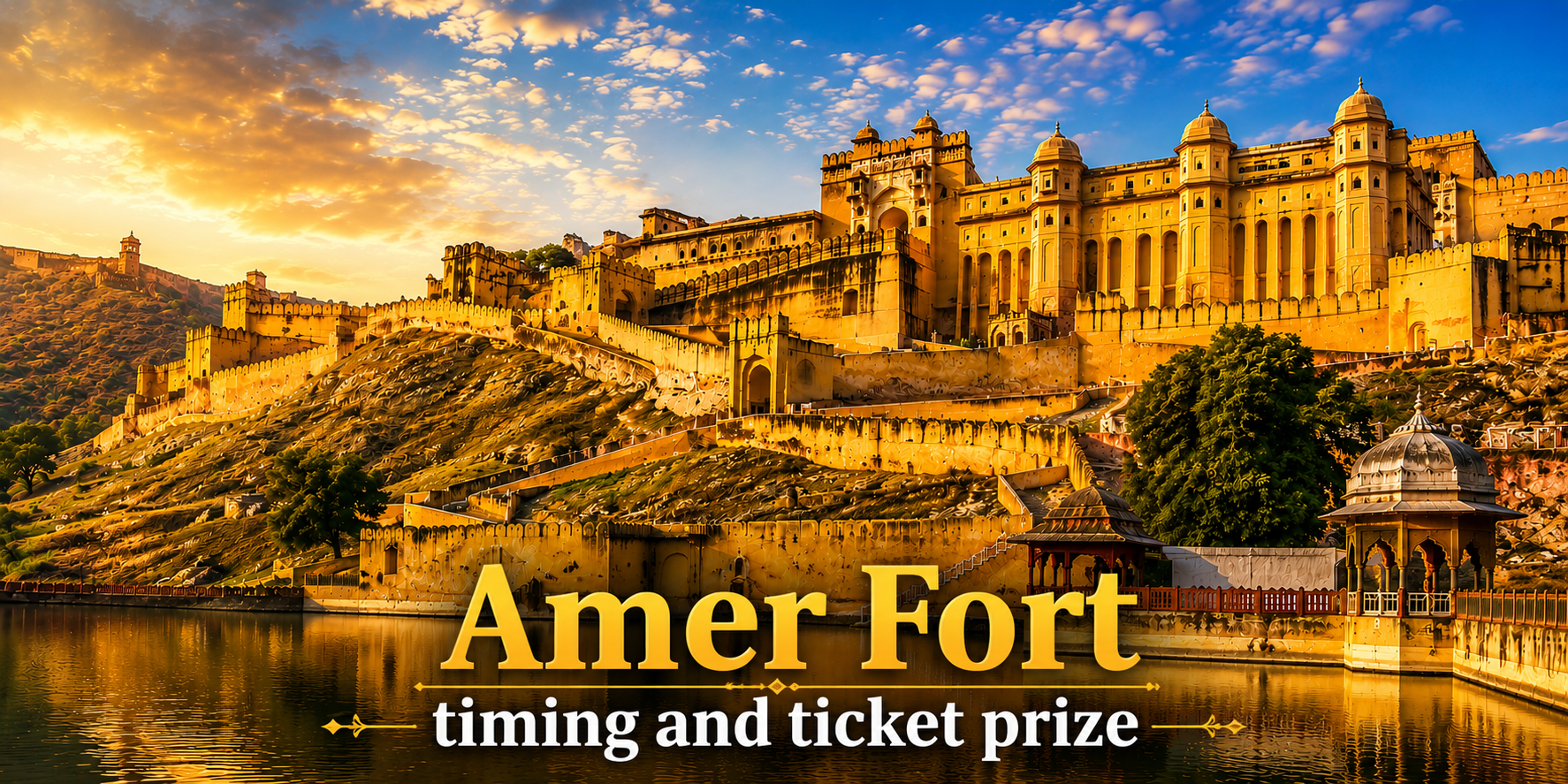
Amer Fort Jaipur: Timings, Ticket Price & Visitor Guide
Amer Fort has a timing problem. Not the official hours; those are simple enough. The problem is that many visitors arrive when Jaipur has already warmed up, join the longest queues of the day and then wonder why a palace above a lake feels like hard work.
Come early and it is a different place.
At opening time, Jaleb Chowk still has room to breathe, the climb is tolerable and Ganesh Pol can be admired without a forest of phones in front of it. By late morning, tour groups tend to bunch up at the same gates and mirrored rooms. The fort is still splendid, of course. You just spend more of the morning shuffling than looking.
For planning purposes, Amer Fort Jaipur works to an 8:00 am opening and a 5:30 pm daytime close. Budget ₹200 per Indian adult. The overseas-adult fare is far steeper: ₹1,000. Two hours inside can feel tight; three gives you room to stop, look up and occasionally take the wrong passage. Add Jaigarh and the outing becomes a half-day.
Amer Fort timings and tickets: the short version
| What you need | 2026 planning details |
|---|---|
| Daytime hours | 8:00 am–5:30 pm |
| Indian adult ticket | ₹200 |
| Foreign adult ticket | ₹1,000 |
| Sensible arrival | Between 8:00 and 9:00 am |
| Time inside | 2–3 hours; longer with a guide |
| Distance from Jaipur | About 11 km from the central city |
| Easiest weather | October to March |
| Jaigarh combination | Allow roughly half a day |
These figures are good for planning, not for cutting things to the minute. A ticket window can stop selling before every visitor space closes, while repairs or official events occasionally change the route through the palace.
There is a case for setting an early alarm
The schedule listed by Rajasthan Tourism runs from 8:00 am until 5:30 pm. Amer normally opens every day, though a state function, a security change or conservation work can upset that routine.
The first hour is not empty, particularly in winter. It is simply calmer. You are less likely to queue behind a coach party, and the eastern light around Maota Lake is kinder to photographs than the pale glare that arrives later.
Five o’clock looks acceptable on paper. In practice, it buys a hurried dash through a palace that punishes hurry. If morning will not work, I would aim to be through the gate by three.
The 2026 Amer Fort ticket price
Rajasthan changed admission charges at state-run monuments from 1 January 2026. At Amer, the reported adult prices are ₹200 for an Indian visitor and ₹1,000 for a visitor from overseas.
Students have separate categories, and the card matters. Bring the real institutional ID. A fuzzy image buried in a phone gallery may not persuade the person at the window, especially with a queue building behind you. Child rules and occasional free-entry arrangements can shift, so check the Rajasthan monument ticket portal shortly before the visit.
The basic palace ticket does not turn the morning into an all-inclusive outing. A jeep, private guide, audio guide, Jaigarh admission and the night programme are separate costs.
That catches people out.
The composite pass question
Jaipur’s monument passes can be good value if Amer, Hawa Mahal, Jantar Mantar, Nahargarh and Albert Hall are genuinely on your route. One catch: City Palace and Jaigarh are managed separately. Sharing space on a tourist map does not pull them under the same pass.
Count the places you honestly want to see before paying. The pass loses its charm the moment it turns a holiday into a race between five ticket gates.
So, is two hours enough?
Two hours will cover the main palace at a steady pace. Three feels better. With a thoughtful guide, a weakness for painted gateways or a camera that comes out every five minutes, time disappears surprisingly quickly.
- About 90 minutes: possible, but hurried. Expect to skim the history.
- Two to three hours: comfortable for most first-time visitors.
- Half a day: a sensible allowance for Amer and Jaigarh together, including the transfer.
People travelling with small children or older relatives often need longer for a less obvious reason: the pauses. There are stone slopes, irregular steps, bottlenecks and very little pleasure in rushing somebody who is already watching their footing.
Cool months help. An early hour helps more.
November to February is the easiest period for walking around Amer. A December morning may even call for a light jacket, though it will probably be tied around your waist by lunch. October and March are warmer but still manageable with an early start.
Summer is blunt about things. From the bottom, the slope looks almost too easy. Try it at one on a May afternoon and your opinion changes fast. Even the pale stone seems to radiate warmth; shade feels irritatingly scarce.
Rain changes the mood. From July to September, the surrounding hills pick up more colour and Maota Lake can look especially good, but polished stone and wet steps are an awkward combination. Grippy shoes beat fashionable ones.
If dates are fixed, do not overthink the season. Change the hour instead.
Inside Amer: follow the palace, not the crowd
Amer unfolds from public space to private space. That sequence is the key to understanding it: a large arrival court, formal audience areas, a richly painted gateway and, beyond it, rooms meant for a much smaller circle.
Follow that order and the complex makes sense. Dart between famous photo spots and it can feel like a handsome collection of disconnected courtyards.
Jaleb Chowk is more than an entrance
Jaleb Chowk once handled returning armies, processions and public display. Today, much of its drama is lost beneath the practical business of tickets, guides and group assembly. Stand still for a minute before moving uphill. Its size tells you who the audience was meant to be.
Suraj Pol and Chand Pol open into this space from different sides. The route you use depends on how you came up, so do not worry if it fails to match a travel video exactly.
Ganesh Pol rewards a closer look
Ganesh Pol gets photographed relentlessly, with good reason. The painted floral work remains delicate even at a distance, and the small figure of Ganesha above the entrance is easy to miss when everybody is concentrating on symmetry.
Take the wide shot, then step aside and study the colour around the arches. Everyone gets a turn. A minor miracle at a popular monument.
Do not hurry past Diwan-i-Aam
Sheesh Mahal gets the glamour shots. That is probably why groups hurry through the Hall of Public Audience next door. Slow down here: columns control shade and sightlines, while platforms, thresholds and approaches quietly tell everyone where rank begins. A good guide earns the fee in this room.
Sheesh Mahal is busy, beautiful and difficult to photograph
Small mirror pieces were arranged to scatter limited light across the room. The effect is finer and more intricate than the aggressively bright photographs found online.
Flash rarely improves matters. A steady hand and a phone’s night setting usually produce a softer result, with the added advantage of not dazzling the person standing beside you. Barriers protect fragile work, not merely the best camera angle.
Sukh Niwas has the cleverest detail
Sukh Niwas used water and passing air to cool its rooms. Compared with the mirror work next door, a stone channel sounds modest. Yet it is one of Amer’s most memorable ideas because it deals with a problem every visitor already understands: Jaipur gets hot.
The private quarters need context
The zenana rooms sit around courtyards connected by passages that begin to resemble one another after a while. A plan helps. So does a guide who can explain movement, privacy and the relationships between the royal apartments without filling every silence with a date.
Shila Devi Temple remains active. Shoes come off where requested, voices drop and cameras stay away from worshippers unless permission is clear.
Four centuries in a few useful paragraphs
Amer served as the Kachhwaha capital before Jaipur existed. Most accounts place the start of Raja Man Singh I’s major palace work around 1592. What stands today was not finished in one grand burst. Later rulers altered it, adding gates and gardens, audience halls and increasingly private rooms.
This is where neat architectural labels become unhelpful. Rajput ideas and Mughal court influence share the same walls: controlled approaches outside, then painting, mirror work, gardens and clever water systems within. The balance of power moved downhill in 1727, when Sawai Jai Singh II founded Jaipur on the plains.
The old capital kept its symbolic weight. Modern recognition came through UNESCO’s Hill Forts of Rajasthan: Amer is one of six forts in that World Heritage listing, inscribed in 2013.
Amer or Amber?
Same place. Amer Fort and Amer Palace follow the local name; Amber Fort and Amber Palace remain common in English. Do not let the labels throw you. Even maps and ticket pages sometimes switch between the two.
Eleven kilometres, plus Jaipur traffic
The map shows only about 11 kilometres from central Jaipur to Amer. That is the reassuring part. On a clear road the trip is easy; push through old-city traffic on a winter weekend and the same short distance can swallow much of an hour.
Buses leave from areas including Ajmeri Gate and MI Road; Rajasthan Tourism estimates about 40 minutes in ordinary conditions. Autos work for one or two travellers, although the agreed price needs to cover whatever you expect—one way, waiting or a return.
A car is easier for families and for a day linking Amer with Jaigarh and central Jaipur. Our Jaipur car-rental options are useful when you would rather fix the vehicle and route in advance.
Leave breathing room after the visit. A train booked too close to an Amer departure turns ordinary traffic into a crisis.
That final uphill stretch
Visitors generally walk or use an authorised jeep, depending on current access rules. The climb is reasonable in cool weather and unpleasant in strong sun. Anyone with knee trouble or reduced mobility should ask about the easiest available drop-off before committing to the walking route.
Elephant rides have long been associated with Amer. Travellers with animal-welfare concerns have clear alternatives: walk when conditions suit, or use motorised transport. There is no need to be talked into an experience that feels wrong.
A guide can help—or get in the way
The difference lies in the questions asked before the tour. Is the guide authorised? How long is the visit? Which sections are included? What is the total price?
A strong guide joins the architecture, court life and water systems into a story, then knows when to stop talking. A weak one rushes to predetermined photo points and develops a sudden enthusiasm for shops. Agreeing on the route early prevents an awkward argument later.
Going alone is perfectly workable. Save a basic palace plan on your phone before leaving the hotel; crowded sites are a poor place to discover that mobile data has slowed to a crawl.
The light and sound show is a separate outing
The evening programme uses the illuminated fort as a backdrop for Amer’s history. It requires another ticket, and daytime admission does not usually allow visitors to remain in the palace until showtime.
| Season | English | Hindi |
|---|---|---|
| October–February | 6:30 pm | 7:30 pm |
| March–April | 7:00 pm | 8:00 pm |
| May–September | 7:30 pm | 8:30 pm |
Rajasthan Tourism notes an odd exception for 1–10 October, when the English performance may move to 8:30 pm. Treat every evening time as provisional. Rain, maintenance or an event can rearrange the board, so confirm both the language and the slot that day.
Should Jaigarh come next?
Usually, yes. Jaigarh stands above Amer and supplies the military half of the story. The two forts may look joined from below, but separate tickets and road access still matter. Heritage paths can close without much notice, so ask staff before setting off on foot.
Panna Meena ka Kund and Jagat Shiromani Temple are nearby, though neither needs to be forced into an already full morning. Stay within the permitted area at the stepwell. Jagat Shiromani is a working temple, not another photo set; dress with that in mind and follow the cues of worshippers.
Trying to fit Hawa Mahal, City Palace and Jantar Mantar into the same trip? A planned Jaipur sightseeing day saves repeated haggling over the next ride—hardly the travel memory anyone came for.
A few annoyances you can avoid
Good grip matters. Fancy travel gear mostly does not. Carry water if security rules allow it, sun protection, photo ID and a little cash alongside UPI or cards.
Keep the bag small.
For families, a lightweight child carrier tends to cope with old stone better than a stroller. Wheelchair users and travellers with reduced mobility should contact the site or tour operator before arrival, since vehicle access helps with the approach but does not make the palace step-free.
Drones need permission. Painted walls and mirror work do not need fingers. And a narrow gateway is not the place for a ten-minute portrait session while everybody else waits.
Do not turn Jaipur into a checklist
Be at Amer when the doors open, then let the morning run. Jaigarh earns the detour for travellers who really enjoy military history. Everyone else can head back for lunch before tiredness starts making the decisions.
After lunch, pick City Palace or Jantar Mantar—both only if enthusiasm survives. Hawa Mahal is a pleasing façade stop once the light softens, perhaps followed by a short market walk. If another museum sounds grim, swap it for a Jaipur walking tour and hear the city at street level.
That is a full day. It does not need rescuing with three more stops.
Amer Fort questions people actually ask
When can I go inside Amer Fort?
Doors are scheduled to open at 8:00 am, with daytime visiting until 5:30 pm. The payoff for getting there as the gate opens: less heat, fewer people and no need to rush.
How much should I budget for admission?
In 2026, allow ₹200 for an Indian adult ticket. The reported overseas-adult price is ₹1,000. Students and children fall under different rules, so bring any ID that supports a concession.
How long should I spend there?
Two to three hours suits most first visits. Keep half a day for Amer and Jaigarh together.
Who built Amer Fort?
Raja Man Singh I began major work on the present palace in the late sixteenth century. Successive Kachhwaha rulers expanded it.
Are Amer Fort and Amber Fort different?
No. They are two spellings for the same palace-fort complex.
Can I visit without a guide?
Yes. The route is manageable independently, though a good authorised guide adds context to the audience halls and private quarters.
Is the evening show included?
No. The light and sound show has a separate ticket and seasonal schedule.
Can Amer and Hawa Mahal fit into one day?
Comfortably, if Amer comes first. Return to central Jaipur after lunch and keep the old-city plan reasonably compact.
One last reality check
Amer is not difficult to visit. It becomes difficult when the morning starts late, the bag is heavy and five more monuments are waiting on a spreadsheet.
Set the alarm. Wear decent shoes. Give the palace the time it has earned.
If transport and the rest of Jaipur need arranging, compare the Jaipur sightseeing options or contact Colours India Tours with your date and group size.